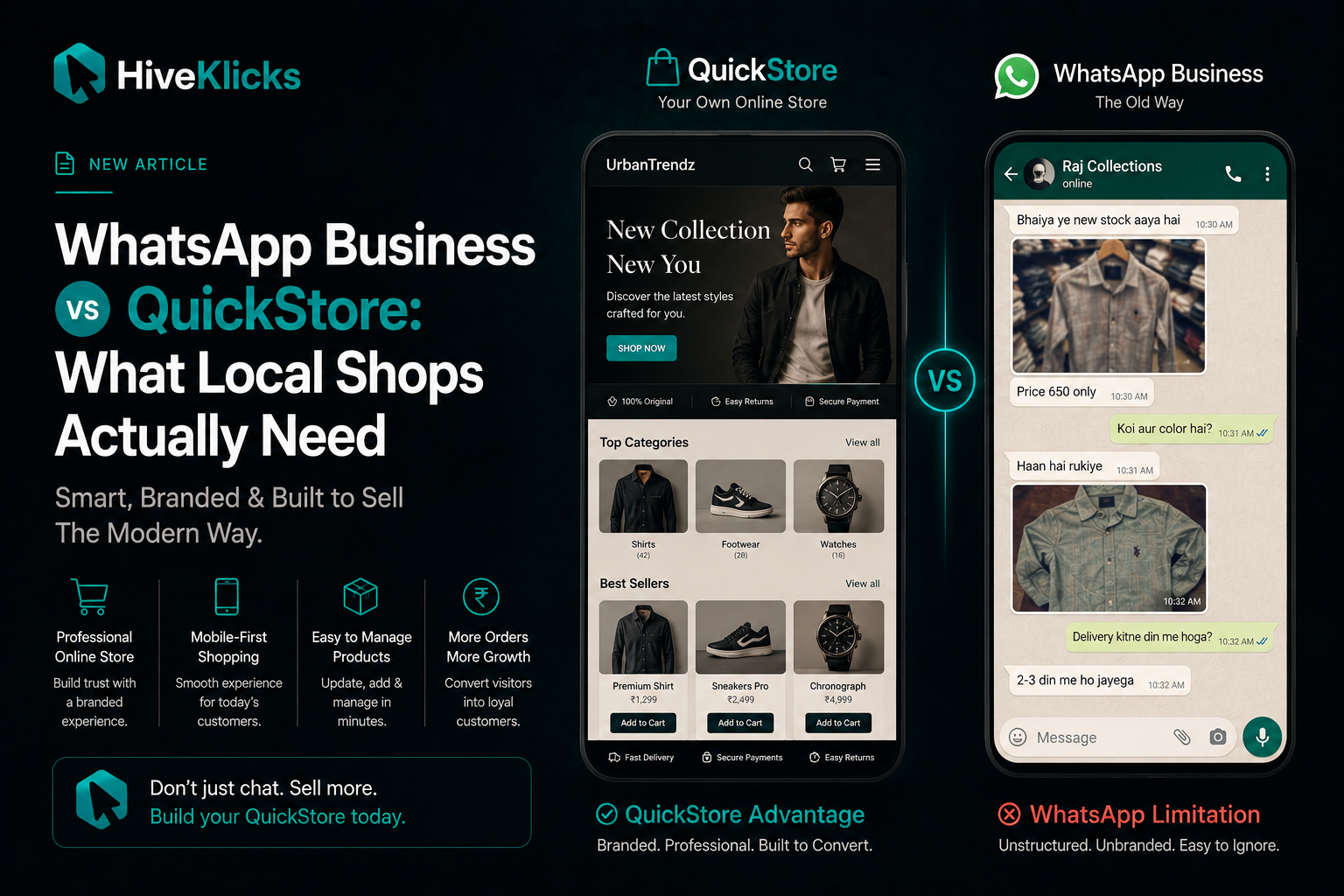
There is a familiar scene playing out every evening in Muzaffarpur, Patna, Hajipur, and dozens of small market lanes across Bihar. A saree shop owner sits at the counter, phone in hand, scrolling through fifty unread WhatsApp messages from customers asking for the same three things: "price kya hai?", "aur photos bhejiye", and "size available hai?". He copies the same answer for the tenth time today. Somewhere in those chats, an order is half-confirmed. Another is half-cancelled. He's not sure which.
WhatsApp Business made all of this possible. Five years ago, this same shop owner had no way to talk to a customer outside of shop hours. Today, he sells until midnight from his sofa. That is real progress, and it deserves credit.
But there is a moment — usually somewhere between the 30th product photo and the 100th customer chat — when the same tool that opened the door starts becoming the door he keeps tripping over. Orders get lost. Photos get repeated. The shop feels busy but doesn't feel like a brand. And then comes the quiet question: "Yeh sab manage kaise hoga jab aur badhega?"
This article is for that exact moment. It is not an attack on WhatsApp Business. We genuinely believe it is the perfect starting point for any local retailer in Bihar. But it is also not the finishing line. There is a clear, calm next step — a branded online catalogue for your shop — and the gap between the two is bigger than most owners realise.
Why WhatsApp Business Is the Right Place to Start
Let's start by giving WhatsApp Business its due. For a shop owner who has never touched a website builder, the app is genuinely a gift:
- Zero learning curve. If you can send a photo to your cousin, you can run a WhatsApp Business catalogue.
- Instant trust. Customers in Bihar already use WhatsApp for everything — family chats, school updates, bank OTPs. Selling there feels familiar, not foreign.
- Direct conversations. Negotiation, size suggestions, festival enquiries — everything happens 1:1, exactly the way Indian retail has always worked.
- Free to use. No subscription, no developer, no hosting. Open the app, set the catalogue, start replying.
- Built-in marketing. Status updates reach your most loyal customers without paying for an ad.
So if you are a brand-new boutique in Brahmpura, or a jewellery store just starting Instagram in Patna's Bailey Road, or a cosmetics counter testing online sales for the first time — start on WhatsApp. Don't overthink it. Don't pay anyone for a website yet. Build proof that customers will buy from you online at all. That is step one, and WhatsApp Business is built for it.
The trouble begins quietly, not loudly. Most shop owners don't notice it until it is already costing them.
Where WhatsApp Business Quietly Hits a Ceiling
WhatsApp was designed as a chat app. It was never designed as a retail backend. As long as you are sending a few photos a day and tracking orders in your head, you will not feel the limits. But as your shop grows — even slightly — the same five problems start showing up in every conversation we have with retailers across Muzaffarpur and Patna.
1. Order Management Becomes a Mess of Scrolling
The first sign of growth is also the first sign of pain. Suddenly there are 40 chats open. Three of them are confirmed orders. Two are about returns. One is a wholesale enquiry. Four are old customers asking for restock. And one is your mother asking if you've eaten.
WhatsApp gives you no way to filter "paid orders" from "browsing customers" from "complaints." Everything sits in the same vertical scroll. You start writing things on paper. You miss replies. A customer waits 18 hours and quietly buys from the shop in the next gali instead.
The chat app didn't fail you. It simply was not built to be a sales pipeline.
2. Product Discovery Is Almost Impossible
Imagine walking into a saree shop in Sutapatti where every saree is wrapped in identical brown paper, stacked in one large pile, with no labels. To see anything, you have to ask the shopkeeper to unwrap them one by one. That is what a WhatsApp catalogue feels like to a new customer.
The WhatsApp Business catalogue has no proper categories, no filters, no "view all in pink," no "show me lehengas under twelve thousand." Customers cannot browse the way they browse Myntra or Meesho or even a small Instagram store. They have to ask. And most customers, especially polite Indian ones, will not ask twice. They will just leave.
3. Branding Is Invisible Inside a Chat
Inside WhatsApp, your shop looks identical to every other contact in the customer's phone. Same green bubble. Same default font. Same generic preview. There is no header, no logo above the fold, no festival banner, no signature look that says this is a premium store.
The product photos that show up are whatever your phone camera captured under the tubelight that morning. That visual sameness is invisible to you because you see it every day. To a new customer, it quietly puts you in the same mental bucket as every other small reseller. Premium pricing becomes harder. Brand recall becomes accidental. Word-of-mouth slows down.
4. Trust Signals Are Weak for New Customers
An existing customer will buy from your WhatsApp because they already trust you. A new customer — one who got your number from an Instagram comment or a friend's referral — has nothing to verify. There is no shop address on your DP. No GST mention. No reviews. No "about us." No photos of your physical store in Chata Chowk or Mithanpura. No team photo. No return policy.
For a saree worth eight thousand or a jewellery piece worth fifty thousand, this absence of trust signals is a real ceiling on order value. Customers will happily buy a five-hundred rupee kurti without checking. They will not transfer fifty thousand to a number with a default DP.
5. Scaling Beyond a Single Owner Is Painful
WhatsApp Business runs on one phone, one number, one person's memory. When you grow to two staff members, you start juggling. When a festival rush hits — Chhath, Teej, Diwali, wedding season — the same phone is meant to handle photos, prices, payments, and panic. WhatsApp Business has a "linked devices" option, but it was not designed for a real retail team workflow.
Owners we work with describe this stage in the same words almost every time: "Sab handle ho raha hai, lekin thoda chaos chal raha hai." The chaos is not your fault. It is what happens when a chat tool is asked to behave like a shop.
One note if you are on the other side of these chats — a manufacturer or wholesaler sending catalogue sets to shops like these. Your ceiling looks different: design numbers, set structure and rates kept on enquiry matter more than order tracking. We cover that in our digital catalogue guide for Surat garment manufacturers.
What "Premium Online Storefront" Actually Means
When most local shop owners hear the word "website," they think of two things: either an expensive Shopify-style store that takes weeks and lakhs to build, or a free Instagram bio link that looks like everyone else's. Both miss the point.
A real online storefront for a local shop in Bihar is something in between. It is a single, beautifully designed, mobile-first page that shows your products the way they would look in a luxury brochure — categorised, photographed cleanly, branded with your logo, fast to load on a 4G phone in Sitamarhi or Sheohar, and built around the one button that actually drives Indian sales: "Chat to Buy on WhatsApp."
This is exactly what HiveKlicks QuickStore is. Not an e-commerce machine. Not a Shopify clone. A premium online catalogue for local shops in Muzaffarpur, Patna and across Bihar — built to live alongside your WhatsApp Business, not replace it.
What it is great at
- One-to-one customer conversations
- Quick replies and price negotiation
- Reaching existing loyal customers
- Zero technical setup, zero monthly cost
- Familiar to every customer in Bihar
What it adds on top
- A branded, shareable shop link
- Categorised, browseable product catalogue
- Premium, consistent product photography
- Trust signals: logo, address, banner, look-and-feel
- "Chat to Buy" on every product — opens WhatsApp pre-filled
This is the actual relationship between the two tools. WhatsApp is the conversation. QuickStore is the showroom. You always needed both. Most local shops just never had the second one in a form they could afford.
Why Product Presentation Matters More Than Most Shop Owners Think
This is the part of the conversation that quietly decides everything else — and it is the part that almost no one talks honestly about.
The single biggest reason a customer picks one saree shop's WhatsApp catalogue over another is not price. It is not even quantity of designs. It is how the product looks in the first thumbnail. The brain decides "this looks premium" or "this looks like aunty's reseller group" within roughly four seconds, and the rest of the buying conversation rides on top of that snap judgement.
Most local shops upload raw photos: harsh tubelight, cluttered background, hangers visible, a corner of the steel almirah, a chappal in the frame, a price written on a sticker. This is not a criticism — it is what every busy owner does when the phone is ringing and a customer is waiting. But every one of those small "rawness" cues compounds. The product looks cheaper than it is. The shop looks smaller than it is. The owner looks newer than they are.
And here is the uncomfortable economics of it: a saree that genuinely costs nine thousand will sell at six thousand if it is photographed badly, and at twelve thousand if it is photographed like a brand. The fabric did not change. The perception did. Perception is priced.
A boutique in Muzaffarpur once told us, "Hum same supplier se uthaate hain jisse Patna ki badi shop uthati hai. Lekin woh ka saree double mein bikta hai." We opened both Instagram accounts. The supplier was the same. The product was the same. The photos were not. — Notes from a HiveKlicks consultation, 2026
What HiveKlicks Does With Your Product Photos
This is the part of QuickStore most shop owners don't realise is included. We treat product imagery as the centre of the work, not the afterthought.
You send us your raw shop photos — the ones you would normally post yourself, taken on whichever phone you have. Our team then turns them into a polished, premium catalogue suite. Specifically:
Custom branded product images
Every product is restyled to match a consistent visual identity for your shop — same framing, same lighting feel, same finish. Your catalogue starts looking like a brand instead of a folder.
Background enhancement
Cluttered tubelight backgrounds, hangers, walls and stray objects are cleaned, replaced or softened. The product becomes the hero of the frame, not the shop interior.
Logo placement & watermarking
Subtle, premium logo placement on every image. Your photos stop being free for screenshot-thieves and start carrying your brand wherever they are forwarded.
Instagram-ready creatives
The same images are repackaged into square and reel-friendly formats — ready to post on Instagram without re-cropping or re-shooting. One photoshoot, every channel.
WhatsApp-ready visuals
Properly sized, properly compressed, properly preview-optimised. Your catalogue loads cleanly even on a 3G phone in interior Bihar, and looks crisp in chat thumbnails.
Premium catalogue styling
Categories, pricing labels, "new arrival" tags, and clean typography across the QuickStore page itself. The whole catalogue starts to feel like a magazine, not a folder.
This is the layer that quietly converts WhatsApp browsers into WhatsApp buyers. And it is the layer almost no DIY website builder gives you, because it is not a software feature — it is creative work done by humans.
What Better Presentation Actually Buys You
It is easy to dismiss "good photos" as a vanity upgrade. Owners who have lived through the shift describe it differently. Better product presentation directly buys you five things:
- Trust — new customers stop second-guessing your shop's seriousness.
- Professionalism — your store reads as a brand, not a side-hustle.
- Premium perception — the same product can be priced higher without resistance.
- Conversions — browsers stop ghosting after the first photo; they ask for more.
- Customer confidence — advance payments and high-value orders become normal.
None of this is magic. It is just the visible cost of looking cheap online, finally paid down.
WhatsApp + QuickStore: How They Actually Work Together
The biggest misconception we encounter is that moving to QuickStore means "leaving WhatsApp." It is the exact opposite. QuickStore is designed to make WhatsApp more powerful, not redundant.
Here is the actual buyer journey we set up for a typical saree shop or boutique in Muzaffarpur:
- A customer sees your Instagram reel or hears about you from a friend.
- Instead of asking for a "WhatsApp catalogue PDF" or fifty product photos, you send one short link — your QuickStore.
- The customer opens it on her phone. She browses your sarees, boutique pieces, jewellery sets or cosmetics — cleanly photographed, properly categorised, with prices clearly visible.
- She finds three pieces she likes. She taps "Chat to Buy" on each.
- Each tap opens a pre-filled WhatsApp message to your number with the product name, code and price already typed.
- You receive a chat where the customer has already done 80% of the work. No more sending fifty repeat photos. No more "price kya hai?" The conversation starts at "I want this, do you have it in pink?"
This single change — pre-filtering your customers through a branded storefront before they hit your inbox — is what shifts a shop from chaotic to compounding. Same WhatsApp. Same owner. Same products. Higher quality conversations. Higher value orders.
A Real Day in a Muzaffarpur Saree Shop — Before and After
The clearest way to see this shift is not in features. It is in what an actual day looks like.
11:00 AM
Owner is forwarding the same six saree photos for the eighth time today, to six different chats. He has not opened the shop's actual stock register yet.
3:00 PM
Three "interested" customers from morning have gone silent. He doesn't know why. He doesn't know which of the four "confirmed" orders will actually pay an advance.
9:00 PM
A new referral lands from Patna. She asks for "your full catalogue." Owner sends 47 separate photos. She replies "thanks" and never comes back.
11:00 AM
Owner sends a single QuickStore link to a new customer with the line "ek baar pura collection dekh lijiye." She browses on her own for nine minutes.
3:00 PM
Three "Chat to Buy" enquiries land with the product code already filled in. He answers all three in under ten minutes, no photo-hunting required.
9:00 PM
The Patna referral shares his QuickStore link in her own family group. Two new customers come in overnight from outside the city. Same owner. Same phone. Wider reach.
None of this requires the owner to learn a new app, change his number, or stop using WhatsApp. The shift is invisible to the customer-facing part. It only changes what is happening behind the scenes.
The Hidden Cost of "Looking Local-Only"
There is a quiet cost to running on WhatsApp alone that most owners never put a number on, but customers feel immediately. It is the cost of looking like a shop that hasn't grown up yet.
Two boutiques in the same lane in Muzaffarpur can be selling almost identical products. One has a branded QuickStore link in her Instagram bio. The other has just a phone number and "DM to order." Even before a single conversation happens, the first boutique is already perceived as more established, more reliable, and more premium. Wedding clients especially — the ones spending fifteen, twenty, thirty thousand on a single outfit — will quietly drift to whoever looks more "real."
That drift compounds. The "more real" looking shop attracts higher-ticket customers, which funds better stock, which attracts even better customers. The other shop stays stuck in the comments section of the first one, doing the harder work of convincing every new lead from zero. Neither shop is doing anything wrong. They are just operating in different perception tiers.
A QuickStore is, in many ways, the cheapest way to step into the higher tier without renting a bigger shop, hiring more staff, or paying for celebrity ads. The whole point of the right kind of online setup for a boutique in Muzaffarpur is exactly this: it lets a small shop look serious without losing its small-shop charm.
Where QuickStore Fits in the Larger Hyperlocal Commerce Shift
The bigger picture here is not just one shop, one tool. It is a generational shift in how local retail in Bihar is being rebuilt. Customers under 35 in Muzaffarpur, Patna, Darbhanga and Bhagalpur are increasingly doing what their counterparts in metros have done for years: deciding where to buy before they ever physically walk in.
They scroll Instagram on the way home. They open a Google search for "best saree shop near me." They check JustDial reviews. They forward a link in their family WhatsApp group and ask "kaisa lag raha hai?" The actual visit to your physical store — if it happens at all — is the last step, not the first. This is the new shape of hyperlocal commerce, and it favours shops that show up properly online before they are even searched for. That Google search is winnable — it is the daily bread of SEO in Patna and SEO in Gaya work as much as it is here in Muzaffarpur.
At the same time, quick commerce has rewired customer expectations. People expect to see a product, get a price, and start a conversation in under sixty seconds. They are not going to wait for you to dig through your phone gallery. A QuickStore meets that expectation. WhatsApp alone, on its own, structurally cannot.
This is also why we treat Instagram and WhatsApp marketing for clothing stores as one connected loop with the QuickStore at its centre. Instagram brings attention. QuickStore holds attention. WhatsApp converts it. Each one becomes more powerful when the other two are doing their job.
Common Worries Local Shop Owners Have (And Honest Answers)
"Mere paas itne products nahi hain. Sirf 20-30 sarees hain."
That is perfect. QuickStore looks better with 25 well-presented products than with 250 cluttered ones. Our Basic plan is built exactly for shops at this scale.
"Customers ko link kholne mein dikkat hogi?"
Every QuickStore is mobile-first and loads in under three seconds even on 4G in interior districts. We test on actual Bihar networks, not on metro Wi-Fi. If a customer can open WhatsApp, they can open QuickStore.
"Main alag se Instagram bhi handle nahi kar paati."
That is exactly the point. The same product images we create for your QuickStore are delivered Instagram-ready. One round of content, two channels covered. No double work.
"Pehle se hi WhatsApp pe sales chal rahi hai. Risk kyun loon?"
You are not switching anything off. QuickStore sits on top of what is already working. WhatsApp keeps doing what it does well — the conversation. QuickStore takes over what WhatsApp was never designed for — the browsing and the branding.
"Photographer ko bulana padega kya?"
No. You send us your phone photos. Our creative team handles the rest — background enhancement, styling, logo placement, formatting. You do not need to buy a camera, hire a photographer, or learn editing.
How to Actually Make the Move — A Calm Checklist
If any of this is resonating, here is the simplest path forward. There is no need to overhaul anything. Just keep doing what is working and quietly upgrade the parts that are not.
- Keep using WhatsApp Business exactly as you do today. Do not change your number.
- Pick your 25, 50, 100 or 150 best products — whatever fits your QuickStore plan.
- Send us your existing phone photos of those products. Don't reshoot anything.
- Share your shop logo, name, and a short description. If you don't have a logo, we will design one.
- Let us handle the rest — image enhancement, layout, hosting, the "Chat to Buy" wiring.
- Within 24 hours, you get a single shareable link. Paste it into your Instagram bio, your WhatsApp status, your Google Business Profile, your visiting card.
- Keep watching where your enquiries are now coming from. They will start arriving with product codes and prices already in the first message.
That is the whole move. No app to learn. No website to maintain. No staff to hire. Just a quieter, more premium way for customers to meet your shop online — and a far less chaotic inbox for you.
Want to see what your shop would look like as a QuickStore?
We build a free, no-obligation mock of your branded storefront before you commit to anything. You see the design, the product presentation, and the WhatsApp flow live. If it doesn't feel right, walk away — no charge. If it does, your QuickStore goes live within 24 hours and your first month is free.
See QuickStore Plans & Free Trial →Why HiveKlicks Is the Right Partner for This Shift
We are not a metro agency emailing decks to Bihar. We are based in Muzaffarpur — our office sits at 1st Floor, Shahi Complex, Chahta Chowk, Muzaffarpur 842001 — and we work hands-on with saree shops, boutiques, jewellery stores, cosmetics retailers and fashion brands across Bihar. The QuickStore product exists because we kept seeing the same gap in the same kind of shop: a great owner with great stock, a strong WhatsApp pulse, and no real online showroom to match.
What we bring to the table is not just software. It is the creative work — the product imagery, the branding, the calm storefront design — that turns a phone-grade catalogue into something a customer is genuinely happy to share with her sister, her mother, her wedding circle. The rest of our work, from local SEO in Muzaffarpur to brand identity to social media management, plugs into the same storefront. Everything starts pointing in one direction: the link customers can actually browse.
You can read more on the broader shift in how a professional online presence is now built for local businesses, and how Bihar shops are already moving towards Google-and-Instagram-led local marketing. None of it requires you to become a "tech business." All of it requires your shop to be seen properly.
The Honest Bottom Line
WhatsApp Business will keep being the right place to start a local shop online in Bihar. That is not going to change in 2026, or 2027. It is the most accessible, most familiar, most trusted entry point into local retail digitisation we have.
But "start" and "scale" are different problems. The moment your shop wants to be perceived as a brand — not just a seller — you need a layer above the chat: a branded, mobile-first, premium-looking catalogue that does the seeing-and-deciding work, while WhatsApp continues to do the talking-and-trusting work.
That is the role HiveKlicks QuickStore was built for. Not to compete with WhatsApp. To finish what WhatsApp started.
If your shop has crossed the moment where the chat inbox feels heavier than the shutter at closing time — that is the signal. The next step is not "more posts." It is a quieter, more confident storefront that customers can actually walk through on their phone before they ever DM you.