A foundation is built from the bottom.
Seven years, seven books. Each year at Sankalp adds one study habit to the ones beneath it.
Kankarbagh, Patna
A stronger foundation for life: after-school classes for Class 6 to 12, plus JEE and NEET, twenty-four to a batch.

Seven years, seven books. Each year at Sankalp adds one study habit to the ones beneath it.
Class 6
One subject, one desk, one sitting, with the phone in a locker downstairs. It sounds like nothing. Every later year stands on it, so it is taught first and on purpose.
On the syllabusFractions and ratios, light and shadows, the first full paragraph.
Class 7
Algebra arrives, and with it one rule: an answer without its steps earns nothing here. By March the steps are automatic, which is what a board examiner will pay marks for.
On the syllabusIntegers and algebra, heat, acids and bases, the first formal letter.
Class 8
Every wrong answer goes into one notebook with the reason beside it: did not know, misread, or rushed. Foundation starts here too. It means the Class 8 book finished properly and one harder problem a day.
On the syllabusLinear equations, force and pressure, cells, the Constitution.
Class 9
The first real jump: thicker books, proofs in maths, numericals in physics. Most marks are lost quietly in the first term. A written test each week means nobody falls behind unnoticed.
On the syllabusPolynomials and Euclid, motion and Newton's laws, atoms and molecules.
Class 10
The first board exam rewards writing as much as knowing. Three full pre-boards, marked the way board examiners mark, with presentation marks counted apart from knowledge marks.
On the syllabusTrigonometry, electricity, chemical reactions, the map question.
Class 11
The stream is chosen: boards, JEE or NEET. It is the steepest year of the seven. Every Sunday night you write the week ahead, and on Saturday we read it back against what happened.
On the syllabusThe start of calculus, mechanics, the mole concept, cell biology.
Class 12
Two exams in one year. The syllabus closes in November. After that come three revision passes on fixed dates, each shorter than the last, and a full mock every second Saturday.
On the syllabusIntegrals, electromagnetism, organic chemistry, genetics.
That is the head start. Not an extra hour of class and not a thicker book. Joining in a later class? We begin with the habits beneath yours, and it takes about a fortnight.
From concepts to confidence. Pick a programme, a class and a board to see the evenings, the room and the fee.
Fees include GST. There is no admission fee, no kit fee and no test-series fee. Leave in any month and the unused part of what you paid comes back within ten working days.
That is the point. A student who knows what happens at 6:30 has one less thing to decide.
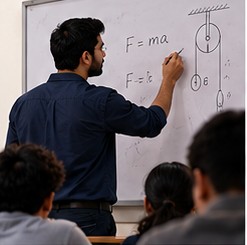
Phones go into a numbered locker at the door. The key stays with you.
Seventy minutes, one idea, on the board. No slides and no recordings.
Tiffin, water and the terrace.
A different subject, the same seat.
Tonight's homework is started here, with a teacher at the doubt desk.
On today's two classes, on paper. The score goes home tonight.
Classes 6 and 7 leave at 6:30. Nobody leaves later than this.
The rules are few. Each one buys something back.
Phones in the locker from 3:45
Three and a half hours with nothing buzzing.
Homework begins in the study hall
Forty minutes at home, not three hours.
A written test every Saturday
No surprises in March.
A missed test is sat on Monday at 3:00
No gap carried into the next chapter.
Out of the gate by 7:30
Dinner at home. Sunday off. Chhath week off.
No parent group and no daily pings. Here are twelve weeks of it for three students. Pick a week.
Toppers make good posters. A parent choosing a batch needs the other number: what happened to all of them.
112 students sat the exam
86 students sat the exam
34 students sat the exam
24 students sat the exam
We do not promise a rank, a percentage or a seat. We promise the routine: the timetable, the Saturday test and the Saturday message.
No visiting faculty and no recorded lectures. If a teacher is away, the class is taught again.
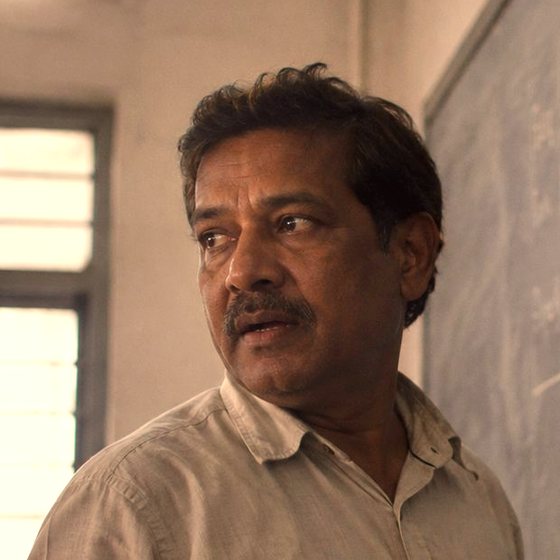
Mathematics, Class 9 to 12
Taught in a Patna school for eleven years before starting Sankalp in 2013. Still takes the Class 9 batch himself.
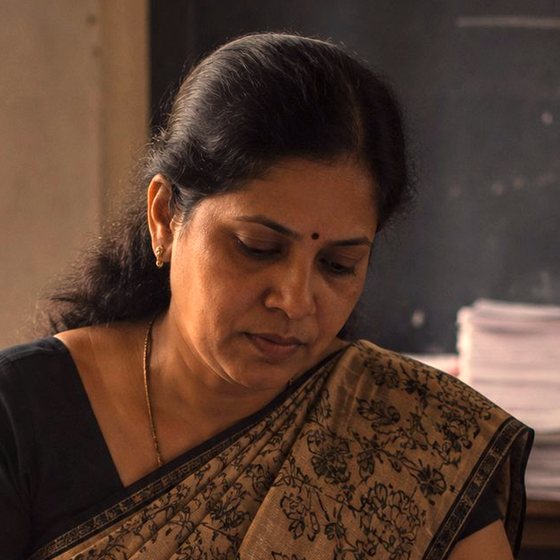
English, Class 6 to 12
Reads every notebook on Friday and writes back in the margin. Students quote those notes years later.
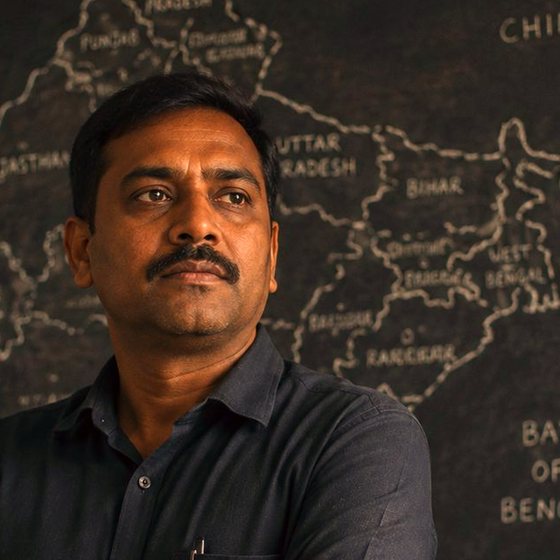
Social Science, Class 6 to 10
Draws India from memory on the board every Monday, and has the class draw it back on Friday.
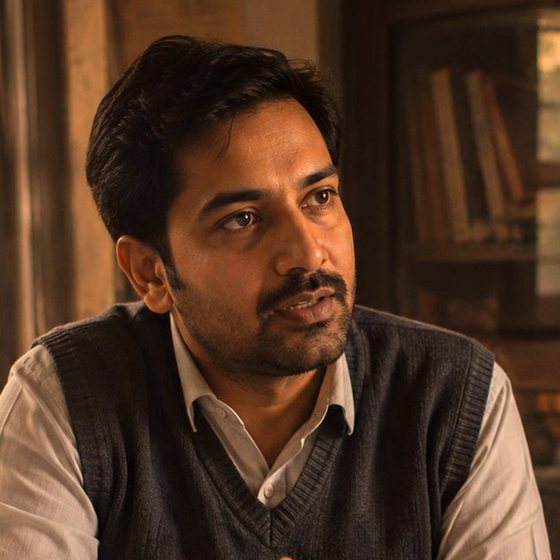
Physics, Class 9 to 12
Starts each chapter with something you can drop, swing or switch on. The formula arrives on day two.
Also in the staff room: Nidhi Kumari, Chemistry. Dr Pallavi Sharan, Biology. Rajnish Thakur, Mathematics for Class 6 to 8. Shweta Rani, Science for Class 6 to 8. Amrita Lal, Hindi and Sanskrit.

“I used to study till one at night and still feel behind. Here I am done by half past seven, and my test marks have stopped swinging.”
“The Saturday message is three lines. In two years I have never had to ask how my son is doing.”
“The error notebook from Class 8 came with me to college. I still keep one.”
CBSE, ICSE and ISC, and Bihar Board. Classes are taught in Hindi and English together. Notes and tests follow your board's language and pattern. Bihar Board papers usually come in February, so that batch closes its syllabus about a month earlier.
No. Foundation here means the school book done properly and one harder problem a day. Entrance batches begin in Class 11, after the Class 10 boards.
Notes are kept at the desk. The missed test is sat on Monday at 3:00, and a teacher sits with them in study hall until they have caught up. We do not send recorded lectures.
On the first Saturday of every month, from 6:00 to 7:30 pm, class by class. Between meetings there is the Saturday message, and the office is open from 11 am to 8 pm.
There is a one-hour placement paper, so we know where to begin. Nobody is turned away on it.
No. We promise the routine. What happened to every student who sat last year's exams is in the results above.
The 2027-28 session starts on Monday, 5 April 2027. Sit through one full evening before you pay anything.

Sankalp Academy, P.C. Colony, Kankarbagh, Patna 800020. The office is open Monday to Saturday, 11 am to 8 pm.
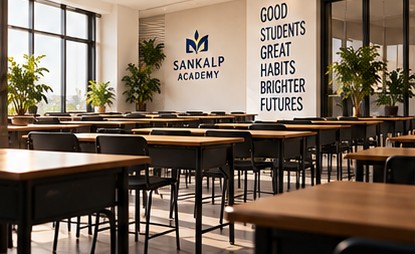
Twenty-two classrooms with twenty-four desks in each. Phone lockers at the door. An inverter on every floor, so the class does not stop when the light goes.