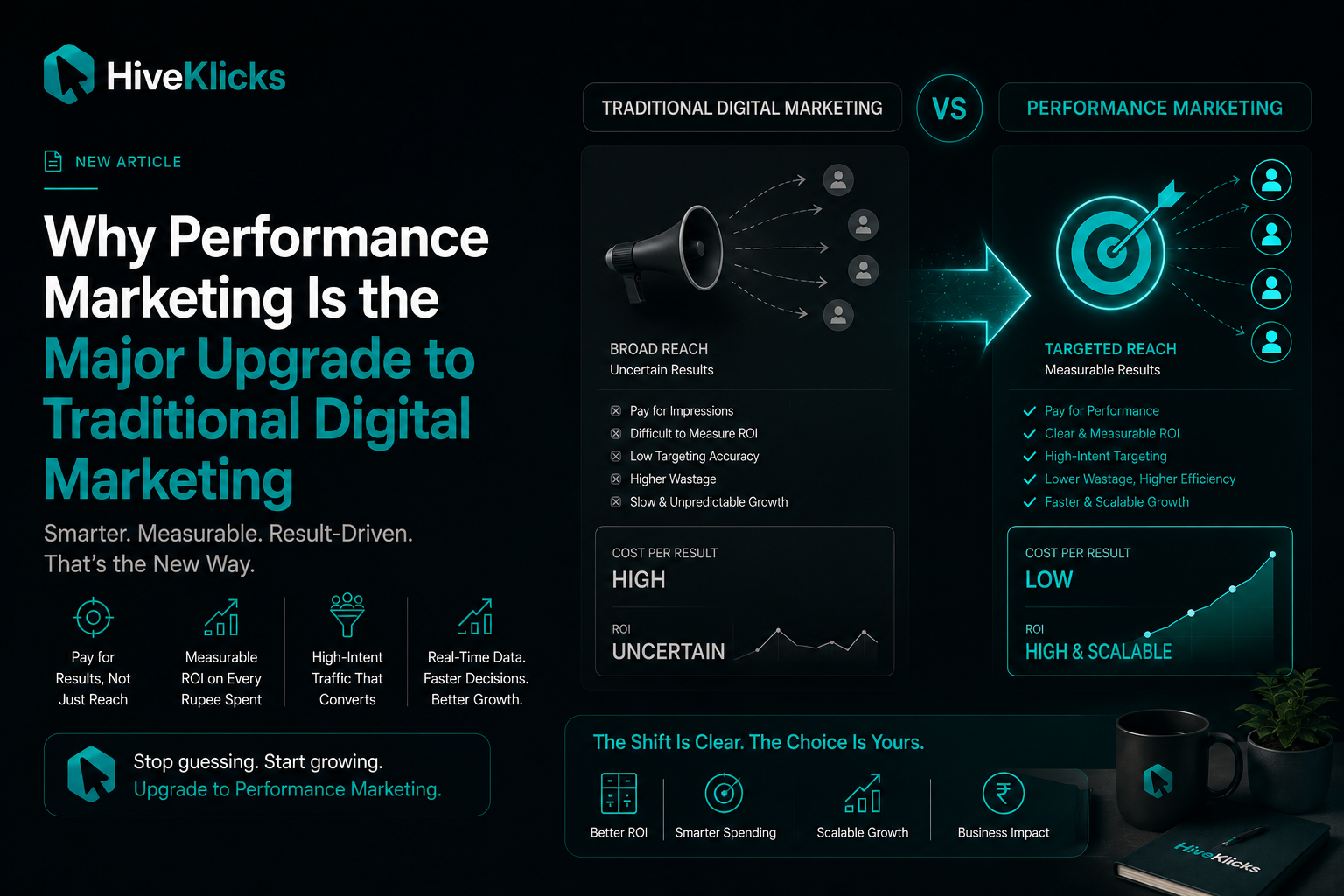
For nearly two decades, digital marketing in India was treated as a generalist craft. A business would post on social media, run a few boosted ads, perhaps invest in some search visibility, and hope that the cumulative effect would translate into customers. For a long time, that approach was enough — simply being online was a competitive advantage. That era is quietly ending.
Across cities like Muzaffarpur, Patna, Hajipur and Darbhanga, a new question is starting to define every conversation between business owners and their marketers: what did we actually get for the money we spent? It is a deceptively simple question, but the answer has reshaped what serious digital growth looks like. The brands that take it seriously are no longer practising digital marketing in its traditional form. They are practising something faster, sharper, and far more accountable — performance marketing.
This piece is not about hype, nor about declaring the death of anything that came before. It is about a structural shift already underway in how growth-stage businesses across Bihar and the rest of India approach customer acquisition, attribution, and modern advertising in 2026. Here, we explore Why Performance Marketing Is the Major Upgrade to Traditional Digital Marketing. If you sense that something has changed in the way the most successful brands around you are growing, you are right. It has.
The thesis of this article is simple: performance marketing is not a tactic, a channel, or a synonym for “running ads.” It is a discipline — the operating model behind how modern digital growth systems are actually built.
Why Vanity Metrics Are Losing Their Grip
For most of the last decade, marketing reports were built around impressions, reach, follower counts and engagement rate. These numbers were comforting. They moved up and to the right. They looked impressive in slide decks. And, crucially, they almost never had to be defended in front of a CFO.
But comfort is not the same as growth. A coaching institute in Muzaffarpur can have 40,000 Instagram followers and still struggle to fill its next admission batch. A boutique hotel in Patna can rack up half a million Reels views and still have a quiet weekend. The disconnect between attention and revenue has become impossible to ignore.
What is shifting is not the existence of these metrics — they still matter as inputs — but their role as outcomes. Today, modern business owners are no longer satisfied when their marketing partner sends a screenshot of follower growth. They want to see qualified inquiries, walk-ins, bookings, signed contracts and revenue attributed to specific campaigns. The trophy metric has changed.
“Likes don’t pay salaries. Leads do.”
The Rise of Measurable Marketing
Measurable marketing did not appear overnight. It is the result of three converging forces.
First, advertising platforms have grown extraordinarily sophisticated. Meta Ads, Google Ads, YouTube and LinkedIn can now optimise campaigns toward genuine business outcomes — leads, purchases, qualified conversations — rather than just clicks. The infrastructure for accountability finally exists.
Second, data tooling has democratised. CRMs, analytics dashboards, attribution platforms and call-tracking systems are now affordable for small and medium businesses. A real estate developer in Patna can now know which Meta ad creative produced last Tuesday’s site visit. That kind of visibility was unimaginable five years ago.
Third — and most importantly — business owners themselves have grown more demanding. The cost of capital has risen, margins are tighter, competition is denser, and customers are harder to win. Spending blindly is no longer a viable option. Every rupee of ad spend must defend itself.
Out of these forces, a new operating model has emerged: marketing as a measurable system, not a creative service.
Figures above are directional industry benchmarks drawn from public reporting across leading ad platforms and SMB performance studies.
What Performance Marketing Actually Means
Performance marketing is often misunderstood. It is not “running ads” — running ads is a tactic, not a philosophy. It is also not the same as paid advertising, although paid channels are usually part of it.
At its core, performance marketing is a discipline that ties every marketing action to a measurable business outcome. It assumes that any campaign, creative, audience, landing page or funnel can be tested, measured, optimised, and either scaled or discarded — based on data, not opinion.
Inside this discipline are several familiar components: Google Ads, Meta Ads, YouTube Ads, retargeting, lead generation, conversion optimisation, landing page experimentation, marketing automation, and analytics. But the orchestration is what defines it. Performance marketing treats these elements as parts of a single revenue-focused growth system — engineered to produce predictable, attributable results.
In practical terms, a serious performance marketing engagement begins with a question no traditional digital agency asks first: what is the cost we can afford to pay for each customer? From that single number, the entire strategy is reverse-engineered. This is exactly the philosophy that shapes HiveKlicks’ performance marketing solutions — an approach built around measurable revenue, not impressions.
Performance Marketing vs Digital Marketing: What’s the Difference?
Digital marketing is the umbrella; performance marketing is one way of running what sits under it. Digital marketing covers everything a business does to reach customers through digital channels — its website, SEO, social media, email, WhatsApp and paid ads. Performance marketing is the part of that work where spend is tied to a measurable action — a lead, a call, a booking or a sale — and judged on cost per lead, cost per acquisition or return on ad spend.
That is why “performance marketing vs digital marketing — which is better?” is slightly the wrong question. One is not a rival to the other. The useful contrast is between digital marketing run for presence and digital marketing run for measurable outcomes. Side by side, it looks like this:
Traditional Digital Marketing
- Presence-focused — the goal is to be visible.
- Success measured loosely: reach, impressions, engagement.
- Monthly, retrospective reporting.
- Decisions driven by experience and intuition.
- Budget treated as a fixed cost.
- Creative produced in long, slow cycles.
Performance Marketing
- Outcome-focused — the goal is measurable acquisition.
- Success measured precisely: CPL, CPA, ROAS, LTV.
- Continuous, forward-looking reporting.
- Decisions driven by attribution data and testing.
- Budget treated as an investment with a defensible return.
- Creative iterated weekly based on conversion signals.
Both can co-exist in a marketing stack — and in most cases, they should. But the centre of gravity has shifted. The marketing function inside ambitious modern businesses is now built around measurable acquisition, with brand and content layered on top to support it. This is not a stylistic preference. It is a response to economic reality.
Performance Marketing vs Brand, Growth, Social Media and Affiliate Marketing
Search for performance marketing and you will find it set against half a dozen other labels. Some are channels, some are business models and some are philosophies, so the comparisons are not all like-for-like. The table puts them on the same footing: what each one optimises for, how success is measured, and how long it usually takes to show.
| Approach | Optimises for | Measured by | Typical time to show |
|---|---|---|---|
| Performance marketing | A specific action: a lead, call, booking or sale | Cost per lead, cost per acquisition, ROAS | Days to weeks |
| Brand marketing | Being remembered and trusted | Recall, branded searches, pricing power | Months to years |
| Growth marketing | The whole customer lifecycle | Activation, retention, referrals, lifetime value | Weeks to months |
| Social media marketing | Attention and community on social platforms | Reach and engagement (organic); leads and sales (paid) | Depends on organic vs paid |
| Affiliate marketing | Sales driven by third-party promoters | Commission paid per sale or lead | Weeks, once partners are active |
| Media buying | Placing ads in the right inventory at the right price | Cost per thousand impressions, reach, placement quality | Immediate delivery |
| Traditional (offline) marketing | Broad local reach | Circulation, footfall, calls to a tracked number | Weeks, hard to attribute |
| SEO | Being found for searches people already make | Rankings, organic traffic, organic leads | Three to six months, then compounds |
Performance marketing vs brand marketing
Brand marketing builds the memory and trust that create future demand; performance marketing captures the demand that exists now. They work on different clocks, which is why they are so often misjudged against each other: a brand campaign looks wasteful on a cost-per-lead report, and a lead-generation campaign looks shallow on a brand-recall survey. In practice each makes the other stronger. A name people already recognise earns more clicks at the same bid, so a steady brand presence tends to lower cost per lead over time.
The most cited research on the balance — Les Binet and Peter Field’s work for the IPA — found that established consumer brands did best with roughly 60% of effort on brand building and 40% on activation. A young local business usually tilts the other way at first, because it needs cash flow before it can afford patience.
Performance marketing vs growth marketing
Growth marketing is the wider frame. It looks at the entire journey — acquisition, activation, retention and referral — and runs experiments at every stage, including the product itself. Performance marketing is mostly the acquisition part of that journey. A Patna coaching institute doing growth marketing would care not only about admission inquiries from ads, which is performance marketing, but also about demo-class attendance, fee completion and how many students refer a friend the next session.
Performance marketing vs social media marketing
Social media marketing is a set of channels; performance marketing is a way of running channels. The two overlap rather than compete. Organic posting on Instagram or Facebook builds reach and trust and is judged on engagement. The moment you run a Meta lead-form campaign optimised for inquiries and judge it on cost per qualified lead, you are doing performance marketing on a social channel. Most local businesses need both halves, which is how we approach social media marketing in Patna: organic content for trust, paid campaigns for measurable inquiries.
Performance marketing vs affiliate marketing
Affiliate marketing is one form of performance marketing: third-party publishers, creators or cashback sites promote your product and earn a commission only when a sale or lead happens. You pay only for results, but you give up control over where and how your brand appears. It suits ecommerce and D2C brands with online checkout far better than a clinic, a school or a local service business, which are usually better served by campaigns they run and control themselves.
Performance marketing vs media buying
Media buying is the act of purchasing ad inventory — slots on Google, Meta, YouTube, television, radio, print or hoardings — at the best price for the audience you want. It is an essential skill inside performance marketing, but it stops at placement. Performance marketing carries on after the ad is bought: conversion tracking, landing pages, lead quality, creative testing and moving budget toward whatever is producing customers.
Performance marketing vs traditional (offline) marketing
Newspaper inserts, hoardings, local radio, pamphlets and auto-rickshaw branding still reach a lot of people in Bihar, and for some moments — a showroom opening, an admission-season announcement — they remain useful. Their weakness is attribution: you rarely know which rupee brought which customer. You can close part of that gap by giving each offline placement its own phone number, QR code or offer code, which makes a traditional campaign at least partly measurable. Performance marketing starts from that measurement instead of adding it at the end.
Performance marketing vs SEO
SEO earns visibility you do not pay for per click, and it compounds slowly; performance marketing buys visibility and delivers quickly. They work better as partners than as alternatives, which the SEO and performance marketing synergy section below covers in detail.
Which Is Best for Your Business?
There is no universal winner, but there is usually a sensible starting point. It depends on what the business needs most in the next few months:
- You need inquiries this month. Start with performance marketing on high-intent demand — Google Search campaigns for people already looking for what you sell, and lead-form ads with a fast WhatsApp or call follow-up.
- Nobody in your area knows your name yet. Pair performance campaigns with brand basics: a consistent identity, a complete Google Business Profile, reviews and regular social content. Paid campaigns convert better when the name already feels familiar.
- You already have steady customers. Look at growth levers before spending more on acquisition. Repeat purchases, WhatsApp follow-ups, reviews and referrals often bring in the cheapest customers you will ever win.
- You sell online across India. Start with performance marketing and strong tracking; affiliate and creator programmes can be layered on once your unit economics are clear.
- You can wait six months for a return. Invest in SEO alongside paid campaigns so that organic search gradually takes over part of the load.
Whatever the starting point, the test stays the same: can you say what each rupee produced? If the answer is yes, you are already practising performance marketing, whatever the report calls it.
Why Modern Businesses Prefer Measurable Growth
Sit inside any growth-stage business in Bihar today, and you will hear a familiar question being asked across departments: if we spend more, can we predict what we get? That single question is the entire reason performance marketing has become the dominant approach.
A measurable marketing system gives the business owner three things that traditional approaches struggle to offer. It gives predictability — once you know your cost per lead, you can plan revenue against ad spend. It gives control — you can pause, scale, or pivot campaigns within hours instead of months. And it gives defensibility — when a founder presents marketing performance to investors or partners, the numbers speak for themselves.
For a small coaching institute, this might mean knowing exactly how many serious admission inquiries each ₹10,000 of monthly spend produces. For a Patna-based D2C ecommerce brand, it might mean shifting budget from low-ROAS audiences to high-LTV cohorts within a single week. For a multi-location restaurant chain, it might mean measuring which branch a campaign actually drove footfall to.
This is what people mean when they say “data-driven marketing.” It is not buzz — it is operating discipline.
Modern growth isn’t about spending more. It’s about knowing what you got for what you spent.
AI, Analytics & the New Decisioning Layer
The other reason this shift is happening now — in 2026 specifically — is artificial intelligence. AI did not invent performance marketing, but it has transformed how it is executed.
Modern campaigns are now optimised by machine learning models in near real time. Algorithms continuously adjust bidding strategies, audience targeting, creative rotation and budget allocation based on signals invisible to the human eye. A campaign that would have required a dedicated media buyer making manual adjustments two years ago can today be steered, in part, by AI-driven campaign systems that improve themselves with every conversion.
Layered above this is analytics — increasingly sophisticated tools that map a customer’s full journey from first impression to final purchase. Attribution modelling, once an enterprise luxury, is now within reach of mid-sized Bihar businesses. So is predictive analytics, which lets brands forecast which leads are likely to convert before a human ever picks up the phone.
The result is a marketing stack that learns. Each campaign cycle compounds the intelligence of the next. This compounding effect is one of the reasons performance marketing budgets tend to become more efficient over time, while traditional digital marketing budgets tend to plateau.
How Local Bihar Businesses Are Adapting
There is a popular assumption that performance marketing is the domain of metro startups and large ecommerce brands. That assumption is becoming outdated.
Across Muzaffarpur, Patna, Bhagalpur and Gaya, a quieter transformation is happening. Local hospitals are running Meta Ads for OPD bookings instead of buying full-page newspaper ads. Coaching institutes are A/B testing landing pages for their admission funnels. Boutique hotels are running geo-targeted Google Ads for direct bookings rather than relying entirely on aggregators. Real estate developers are scoring leads automatically and routing only the warm ones to their sales teams.
These are not theoretical shifts. They are happening every week. The businesses making them are not necessarily the largest in their category — but they are increasingly the most efficient, and that efficiency is starting to compound into market share.
What unites them is a willingness to think of marketing as a measurable growth function rather than a creative one. That single mental shift is what separates the new wave of Bihar businesses from those still buying impressions.
Bihar’s digital ecosystem in 2026 looks dramatically different from what it did even two years ago. Smartphone penetration, UPI-led commerce, and short-form video adoption have created a high-intent audience that responds far better to direct-response advertising than to traditional brand campaigns. Performance marketing simply fits the way Bihar consumers now actually buy.
What Performance Marketing Looks Like Across Sectors
The shape of performance marketing changes meaningfully depending on the industry. A few examples grounded in the local landscape:
Educational institutes and coaching centres
Admission cycles are short, competitive and seasonal. Performance marketing for schools and coaching institutes typically revolves around lead-form ads, retargeting, parent-targeted creatives, and conversion funnels timed precisely around announcement and counselling windows. The unit economics are clean: cost per qualified inquiry, conversion rate to admission, and lifetime tuition value.
Hospitals and clinics
Trust-driven sectors require warmer, more careful campaigns — usually built around informational content, doctor-led video creatives, and OPD-specific landing pages. Measurement here is often appointment volume and call quality, not raw clicks. Sensitive specialities such as fertility, oncology and cardiology benefit hugely from properly structured search and retargeting funnels.
Local ecommerce and D2C brands
For ecommerce scaling, the focus is on ROAS, cohort behaviour, retargeting funnels, abandoned-cart recovery and lifetime value optimisation. The discipline is closer to that of a metro D2C operation, just at a more local cost base. Bihar-based ethnic-wear, snacks and beauty brands are quietly building national footprints this way.
Hotels and restaurants
Bookings and footfall are the only metrics that matter. Geo-fenced ads, intent-keyword Google campaigns, and reservation-tracking landing pages drive the engine. For multi-outlet restaurant brands, store-level attribution is now a realistic expectation rather than a nice-to-have.
Real estate businesses
Long sales cycles, high ticket sizes, and a strong dependence on lead quality. Lead generation, lead scoring, retargeting and CRM-integrated campaigns are non-negotiable. The sales team’s job becomes meaningfully easier when only pre-qualified leads enter the pipeline.
Local retail brands
Stores in Muzaffarpur and Patna are increasingly using Meta Ads, WhatsApp catalogues and local search visibility to drive in-store visits. Walk-in measurement, while imperfect, is now possible through call-tracking, coupon codes and store-level attribution. Boutiques, salons and lifestyle retailers have been among the fastest adopters.
In each case, the unifying principle is the same: every campaign is engineered backwards from a measurable outcome. That is the heart of why scalable, ROI-focused campaign strategies consistently outperform one-off creative pushes — the system itself is built to learn and improve.
Landing Pages & Conversion Funnels — The Infrastructure Nobody Sees
A common misconception is that performance marketing is “about the ad.” It isn’t. It is about what happens after the click.
A well-built ad can deliver thousands of interested visitors, but if your landing page loads slowly, lacks clarity, or fails to capture intent within the first six seconds, every rupee of ad spend leaks out the bottom of the funnel. This is why funnel optimisation has become as important as creative production.
Conversion-grade landing pages, well-structured lead forms, fast page speeds, thumb-stopping creatives, frictionless WhatsApp handoffs, and well-defined retargeting paths form the infrastructure that quietly determines whether a campaign succeeds or fails. Traditional digital marketing treated these as optional. Modern performance marketing treats them as foundational.
The ad gets the click. The landing page earns the lead. The funnel converts the customer. Most failed campaigns aren’t bad campaigns — they’re campaigns running on broken infrastructure.
SEO & Performance Marketing — A Synergy, Not a Rivalry
There is a tendency to position SEO and performance marketing as opposites. They are not. They are complementary engines in the same growth system.
SEO compounds. It rewards patience, content depth and authority. It captures the demand that already exists in the search ecosystem — people actively looking for what you offer. (That compounding engine is exactly what we run as SEO services in Muzaffarpur, SEO services in Patna and SEO services in Gaya.)
Performance marketing creates and accelerates. It places the brand directly in front of audiences that were not necessarily searching, warms them up, and converts those who match buyer profiles.
When the two run in parallel, something interesting happens. SEO informs which keywords and intents are converting organically, which then sharpens paid targeting. Paid campaigns produce engagement data that helps refine content strategy. Each engine makes the other smarter.
For local businesses across Bihar, this synergy is particularly valuable. Organic search builds long-term trust; performance marketing fills the short-term pipeline. Together, they form a durable digital growth system that outlasts platform changes and algorithm updates.
Curious how this would look for your business?
If you’re weighing up whether to stay with a traditional digital marketing setup or transition to a measurable growth model, our team can walk you through what the right structure looks like — tailored to your sector, budget and location.
Book a Strategy Call →Common Mistakes Businesses Make When Moving to Performance Marketing
The transition from traditional marketing to a performance-driven approach is rarely smooth. A few mistakes show up almost universally:
- Treating it as a “campaign” rather than a system. Performance marketing works because it compounds. Two-week bursts rarely deliver the learnings needed to optimise.
- Skipping the foundations. Tracking pixels, conversion events, server-side tagging, CRM integration — these unsexy details are where ROI lives. Brands that skip them never get clean data.
- Chasing the lowest cost per lead. A ₹40 lead that doesn’t convert is more expensive than a ₹400 lead that does. Lead quality matters more than lead volume.
- Constantly switching agencies. Every switch resets the learning curve. The first 60 days are foundational; brands that change partners every quarter never get past them.
- Ignoring creative. Even the best targeting cannot save a weak hook. Creative is the new targeting in 2026 — and performance marketing now lives or dies on the strength of its short-form video and ad-narrative quality.
Avoiding these traps is what separates serious operators from accidental ones.
The Future of Digital Growth
Looking ahead, three trends are becoming clearer.
First, AI will continue absorbing the operational layer of marketing — bidding, audience generation, creative variation, copy testing. Human marketers will increasingly focus on strategy, brand, and creative direction, while the execution layer gets faster and cheaper.
Second, attribution will keep tightening. Privacy changes will reshape tracking, but server-side analytics, first-party data and CRM-driven attribution will fill the gap. The brands that invest now in clean data infrastructure will be the ones still able to measure clearly in 2028.
Third, the line between marketing, sales and product will continue to blur. Performance marketing will not just be a customer-acquisition function — it will become a feedback loop that informs product positioning, pricing, and retention.
For local businesses across Bihar, this future is not abstract. It is the difference between running a business that grows predictably and one that depends on luck. The brands that adopt this mindset early — even at modest budgets — will be operating with a meaningful advantage by the end of this decade.
A Quieter Conclusion (and a Not-So-Quiet Next Step)
Performance marketing is not a louder version of digital marketing. It is a more disciplined one. It does not promise miracles. It promises measurement, accountability and compounding efficiency. For modern businesses in Bihar and beyond, that quieter promise has become the more valuable one.
The shift toward measurable growth is no longer optional. The question for most business owners today is not whether to embrace it, but how soon — and with whom. Choosing a partner who treats campaigns as engineered growth systems, rather than monthly creative deliveries, is the single most important decision in that transition.
If you are ready to move beyond impressions and into measurable, attributable, defensible growth, HiveKlicks helps founders, brands and institutes architect that transition through advanced growth campaigns purpose-built for businesses across Muzaffarpur, Patna and the wider Bihar market.
Related reading on this site: Fixing Google Ads in Bihar · The Hook-First Meta Ads Strategy · Local Business Marketing in Bihar · Digital Marketing in Patna