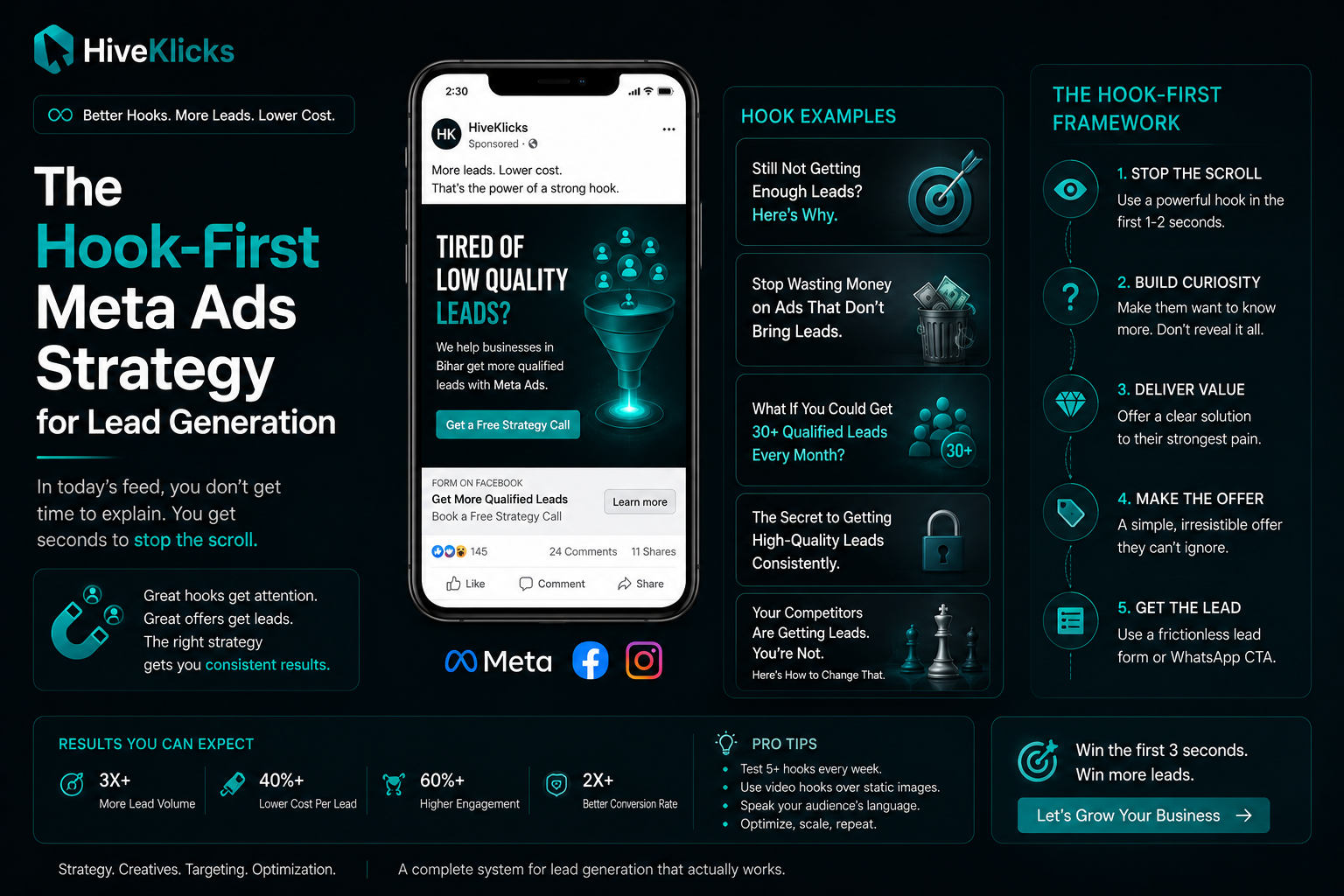
A person searching on Google has arrived with a question, and your ad is one of the answers. A person on Instagram has arrived with nothing in mind at all. Your ad sits between a cousin’s wedding reel and a cricket clip, and a thumb is already moving to take it off the screen.
Most ads lose at that moment. The loss happens before the offer, before the price, before your name has appeared. The viewer did not reject what you sell. They never found out what it was.
And yet most local ads are built as though the viewer had agreed to watch. They open with a logo animation, then “Welcome to” and the business name, then a slow pan across the premises, and reach the point somewhere around second nine. By then nearly everyone has gone.
Hook-first means building the ad in the opposite order. The opening seconds are written first, tested hardest, and given the best material you have. Everything else in the ad exists only for the people the opening has stopped.
What a Hook Is
The hook is whatever the viewer sees and reads before deciding whether to keep watching.
- In a video, it is the first two to three seconds: the first frame, the first words on screen and the first words spoken.
- In an image ad, it is the picture and the largest line of text on it.
- In the caption, it is the first line, because the rest is hidden behind “more”.
It has one job, and the job is small. A hook does not have to sell anything. It has to earn the next three seconds from the right person.
Two practical facts shape how hooks are made. Most people watch with the sound off, so the hook has to work as words on the screen and not only as speech. And most viewing happens in Reels and Stories, so the ad should be shot upright, filling the phone.
Why the First Seconds Set the Cost
It is natural to think of ad cost as a matter of budget and bidding. On Meta, the creative matters at least as much, and the reason is in how the auction works.
Every time an ad could be shown, Meta holds an auction among the advertisers who want that person. The highest bid does not simply win. Meta combines the bid with its own estimate of how likely that person is to respond to the ad, and with a measure of the ad’s quality. An ad that people stop for and act on scores well on the second and third parts, so it wins more auctions at a lower price.
That is the mechanism behind the whole approach. A stronger opening makes more people watch and respond, and Meta in turn charges you less to reach the next person. Two businesses with the same offer and the same budget can pay very different amounts per lead, and the difference is usually in the first three seconds.
Six Hooks That Work for Local Businesses
These are patterns to adapt. The examples are in the mix of Hindi and English that customers in Bihar use, because an ad should sound like the shop it comes from.
Call out the place or the situation
People stop for things that are plainly about them. “Muzaffarpur ke Class 10 parents, yeh 30 second dekh lijiye.” “Is lagan mein shaadi hai? Caterer book karne se pehle yeh dekhiye.” The viewer who is not a Class 10 parent scrolls on, which is what you want. The one who is has been addressed directly.
Put the offer in the first frame
“Bridal lehenga on rent from ₹5,500.” “Diwali tak: 2 kurtas ₹1,499.” A price in the opening does two jobs. It stops people who are in the market, and it turns away people who could never have afforded you before they cost you a lead.
Start on the best frame
The finished plate, the renovated room, the saree draped and worn. Many videos save this for the end as a reveal. Open with it. The build-up can follow for the people who stayed because of what they saw.
Say what they are already wondering
“Coaching join karne se pehle yeh 3 sawaal zaroor poochhiye.” “RO lagwana hai? Pehle paani test karwaiye.” You are not inventing a worry. You are putting into words the one they brought with them, and offering to settle it.
Open against the usual advice
“Sabse sasta inverter mat kharidiye.” “Do not repaint before the monsoon.” A statement that runs against what the viewer expected makes them wait for the reason. It only works when it is true and you can explain it in the next ten seconds.
Use what national brands cannot
The shopfront on Motijheel that everyone in town has walked past. The doctor in person, at the clinic’s own gate. A landmark in the first frame. Recognition stops the scroll faster than polish does, and it is the one advantage a local business has over every national advertiser in the same feed.
The difference is easiest to see side by side.
| The usual opening | A hook-first opening |
|---|---|
| Logo animation, then “Welcome to Sharma Dental Clinic” | The dentist to camera: “Daant mein dard hai? Aaj hi dikhaiye. Boring Road.” |
| “We are the best institute in Bihar” | “42 seats. Naya batch 4 November se.” |
| “Grand Festive Offer!!!” over a stock background | The two kurtas on a hanger, with the price on screen |
| A slow pan across an empty showroom | A customer driving the scooter out of the showroom |
| “Quality products at affordable prices” | “Yeh sofa 12 saal purana hai.” Then show it. |
What Meta Will Not Let You Say
A few rules catch local advertisers out, and an ad that breaks them is rejected or quietly limited.
- Do not tell viewers what is wrong with them. Meta does not allow ads that state or imply personal attributes such as a health condition or financial trouble. “Are you diabetic?” will be refused. “Free diabetes check-up camp, Sunday, Kankarbagh” is fine.
- Avoid before-and-after pictures for health, weight and cosmetic services. Show the treatment, the clinic and the doctor in their place.
- Coaching institutes should keep claims provable. India’s 2024 guidelines on coaching advertisements rule out promises such as guaranteed selection and require a student’s consent before their name or photograph is used. Our plan for coaching institute marketing in Patna covers this in detail.
- Property ads for registered projects should carry the Bihar RERA registration number.
After the Hook: Proof, Offer, Next Step
The hook buys you a few seconds. The rest of the ad has to use them in a fixed order, and most lead ads need no more than 15 to 30 seconds in total.
- Hook (0 to 3 seconds). The opening, as above.
- Proof (3 to 12 seconds). Show that the opening is true. The product in use, the classroom with students in it, the kitchen, the finished job. Show it; a spoken description is weaker.
- Offer (12 to 20 seconds). What exactly is available, what it costs or where prices start, and until when.
- Next step (the last few seconds). One action only. “WhatsApp par ‘Hi’ bhejiye” or “Form bhariye, hum call karenge.”
The rule that holds this together is one ad, one message. An ad for a boutique’s bridal rentals should not also mention the new kurta stock and the tailoring service. Each of those is a separate ad with its own hook.
Where the Lead Goes: Form, WhatsApp or Website
The ad ends by sending the viewer somewhere. There are three choices, and they produce different kinds of lead.
| Route | What you get | Suits | Watch for |
|---|---|---|---|
| Instant Form A form that opens inside Instagram or Facebook, already filled with the person’s details | The most leads at the lowest cost each | Coaching, admissions, property, anything that needs a call back | People submit with one tap and forget. Add a question they must answer, and use the higher-intent setting that makes them confirm. |
| Click to WhatsApp Opens a chat with your business number | A conversation, started by the customer | Boutiques, food, salons, clinics, repairs | Someone has to reply within minutes, with prices and a location pin ready. |
| Website page Opens a page on your site | Fewer leads, usually more serious | Higher-value services where people want detail first | A slow page wastes the click. See our guide to Core Web Vitals. |
For most small businesses in Bihar, WhatsApp is the natural choice, because that is where customers already ask about prices. Whichever route you pick, the lead is only worth something if it is answered quickly. The same follow-up habits that decide whether search ads pay apply here; they are set out in why Google Ads in Bihar often fail to convert.
How to Test Hooks on a Small Budget
You cannot know in advance which opening will work. People who make ads for a living are wrong about this regularly. What you can do is let the audience decide, cheaply.
- Film once, open three or four ways. Shoot the proof, offer and next step a single time. Then record several different openings and edit each on to the same body. The versions now differ only in the first three seconds, so any difference in results comes from the hook.
- Run them together. Put all the versions in one ad set, with one audience and one budget. Meta will send more of the spend to whichever is drawing a response.
- Leave it alone. Meta says an ad set generally needs around fifty results in a week before its delivery settles. A small local budget will often not reach that, which is a reason to run fewer ad sets with a broader audience, and not to edit every other day. Each significant edit restarts the learning.
- Judge on leads. After a week or two, compare the cost per lead and, from your own enquiry register, how many were worth calling. Switch off the weak versions.
- Test the next thing against the winner. Keep the best opening and try a different offer, or a different proof section.
If the budget is very small, test two openings and not four. Two versions with enough data tell you more than four with almost none.
Reading the Numbers
Ads Manager offers dozens of columns. Five figures are enough to tell you which part of an ad is failing.
| Figure | How to get it | What it tells you |
|---|---|---|
| Hook rate | 3-second video plays divided by impressions | Whether the opening stops people. Low means rewrite the first three seconds. |
| Hold rate | ThruPlays divided by 3-second video plays | Whether the middle keeps them. Low means the proof section is weak or slow. |
| Link click rate | Link clicks divided by impressions | Whether the offer earns an action. |
| Cost per lead | Amount spent divided by leads | The efficiency of the whole ad. |
| Cost per useful lead | Amount spent divided by the leads your team judged worth pursuing | The figure that should decide what you keep running. |
Hook rate and hold rate are not columns Meta provides by those names. You work them out from the two video figures it does provide, or set them up as custom metrics. There is no universal good value for either; compare your own versions with each other.
One warning. It is possible to write an opening that wins attention and loses money. A startling or misleading first frame will produce a high hook rate, cheap views and no buyers, because it stopped the wrong people. The opening has to select your customer as well as stop the thumb, which is why the last row of the table outranks the first.
When an Ad Wears Out
An ad that worked well for a fortnight and then faded has usually not gone wrong. It has been seen.
The audience for a local business is small. A boutique advertising to women within a few kilometres of Muzaffarpur, or a clinic advertising to one part of Patna, can reach most of the people available within a couple of weeks. After that the same people see the ad again and again. The figure to watch is frequency, the average number of times each person has seen it. When frequency climbs while cost per lead rises, the audience is tired of that opening.
The cure is cheaper than making a new ad. Keep the body and change the hook. This is the second reason to film several openings at every shoot: one session can supply two months of fresh versions.
Shooting It Without a Studio
None of this needs a production company. A recent phone is enough, and a slightly rough video from the owner often does better than a polished one, because it looks like something a person posted and not like an advertisement.
- Shoot upright, in daylight, facing a window or standing in open shade.
- Use a clip-on microphone. Poor sound loses viewers faster than poor picture, for those who do listen.
- Add captions for everything spoken. Most viewers will read the ad, not hear it.
- Make the first frame count. No black screen, no logo, no “Hello friends”. Start mid-action, with the opening line already on screen.
- Speak the way you speak at the counter. If customers talk to you in Hindi with English mixed in, the ad should too.
- Record five openings before you stop. They take ten minutes and are the most valuable footage of the day.
Where Meta Ads Fit
Meta ads create demand: they put something in front of people who were not looking for it. That makes them the right tool for fashion, food, events, admissions and anything bought on sight or on impulse. They are weaker for needs that people search for at the moment they arise, such as a plumber or a pathology test, which is where search ads and organic visibility do better.
The two work together. An ad makes someone curious, and the next thing they do is search your name. What they find decides the sale: your Google Business Profile, your reviews and your website. That is why paid social is usually paired with local SEO in Patna, SEO in Muzaffarpur or SEO in Gaya, so the search that follows the ad finds something worth finding.
HiveKlicks runs paid and organic social for businesses across the state. Social media management starts from ₹2,999 a month for Facebook and Instagram, and includes Meta ads management for ad budgets up to ₹15,000. The work is described on our pages for social media marketing in Muzaffarpur and social media marketing in Patna, and campaigns across both Meta and Google sit under performance marketing in Bihar.
Want Hooks Written for Your Business?
Tell us what you sell, who buys it and what you are offering this month. On a short call we will suggest a first set of openings you could film on a phone, and say which lead route suits the way your team answers enquiries.
Book a Free Strategy Call →