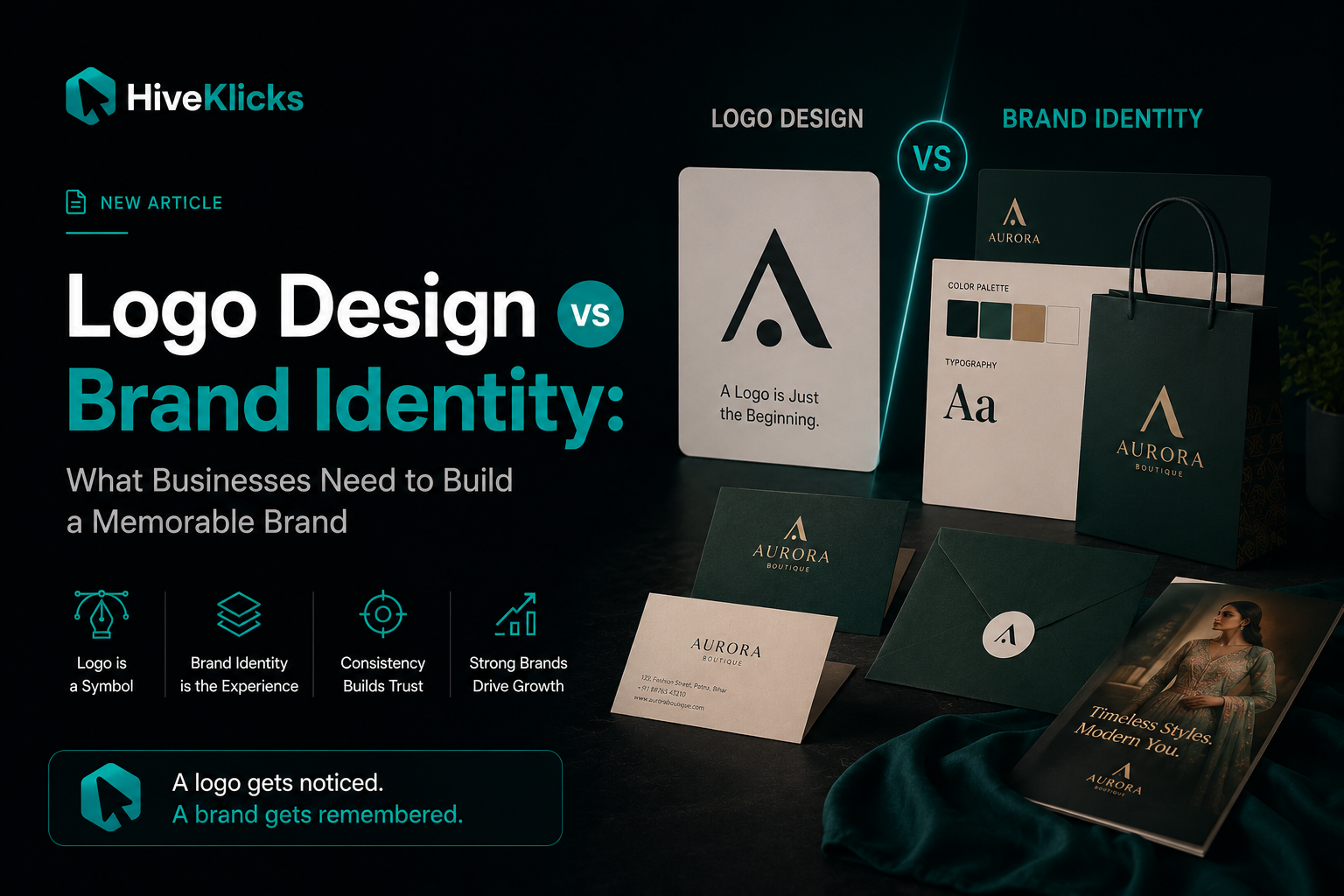
Picture two shops selling almost the same thing, at almost the same price. One has a sharp, modern logo. The other has a sharp, modern logo too. But one of them you remember a week later — you could describe its colours, the feel of its Instagram, the way its packaging looked in your hand. The other one has already blurred into the background of a hundred businesses that all looked fine and felt like nothing.
That gap — between businesses you remember and businesses you forget — is almost never about the logo. It is about brand identity. And the confusion between the two quietly costs business owners money every single day.
Here is the mistake, plainly: a business invests in a logo, gets a nice file back, and believes branding is complete. A logo is real and necessary work. But on its own it is roughly a tenth of what makes a brand. The other nine-tenths — the colours, the typography, the photography, the voice, the packaging, the website, the way everything holds together — is what actually makes a business memorable.
This is the definitive guide to logo design vs brand identity, written for business owners. By the end you will know exactly what a logo is, what a complete brand identity includes, the difference that matters, which one your business needs at its current stage, and how the right branding compounds into real marketing results. No jargon, no fluff — just the version of this you wish someone had explained before you spent the money.
What Is a Logo?
A logo is the single visual mark that identifies your business at a glance. It might be a symbol, a styled wordmark of your name, or a combination of both. Its entire job is recognition — to be the fastest, most repeatable signal that says “this is us.”
What is a logo?
A logo is the visual mark — a symbol, wordmark, or combination — that identifies a business at a glance. Its purpose is instant recognition: to be the quickest, most repeatable signal of who you are. A logo is one part of a brand, not the whole brand.
Think about how a logo actually works in the real world. The Nike swoosh, the half-bitten Apple, the golden arches of McDonald’s — you recognised every one of those without reading a word. That is the power of a strong logo: it becomes a shortcut in the customer’s mind. A good logo design is simple enough to recognise instantly, works at any size from a phone icon to a signboard, and still looks right in a single colour.
A logo also carries your first impression. Before a customer reads your tagline or scrolls your website, the logo has already whispered something — modern or dated, premium or cheap, serious or casual. That whisper happens in a fraction of a second, which is exactly why professional logo design matters.
But notice what a logo cannot do. The Nike swoosh does not tell you how a Nike ad feels, why the packaging looks the way it does, or what the brand stands for. Those things come from everything around the logo. A logo is the front door. It is not the house.
What Is Brand Identity?
If a logo is one mark, brand identity is the entire system that mark lives inside. It is every visual and verbal element your business uses to express who it is — used consistently, everywhere a customer meets you.
What is brand identity?
Brand identity is the complete system of visual and verbal elements a business uses to express who it is — logo, colours, typography, imagery, packaging, website, social media presence and brand voice. Where a logo is a single mark, brand identity is everything a customer sees, reads and feels across every touchpoint.
A complete brand identity usually pulls together:
- Visual identity — the logo plus the full visual language built around it.
- Colours — a defined palette used the same way every time, so your brand becomes recognisable by colour alone.
- Typography — the fonts that carry your name, headlines and body text with a consistent personality.
- Brand voice — how you sound: warm or formal, playful or precise, in captions, emails and replies.
- Messaging — what you say about yourself; your promise, positioning and the words you repeat.
- Photography style — how your products, team and space are shot, lit and edited.
- Packaging — the box, bag, label or wrap a customer actually holds.
- Website appearance — how all of the above comes together on the page customers visit to decide.
- Social media presence — the feed, grid and stories that increasingly act as your real homepage.
Here is the part most owners miss: brand identity is much larger than a logo because customers experience the system, not the symbol. In a typical week a customer might see your Instagram post, tap to your website, read a WhatsApp reply, glance at your signboard and receive your packaging. The logo appears in all of them, but it is the consistency across all of them that builds the feeling of a real brand. One logo, repeated, is not a brand identity. One logo plus a coherent world around it — that is.
Logo Design vs Brand Identity — The Key Differences
This is the comparison most people search for, so here it is in one scannable view. Read it as “a logo does this; a brand identity does all of this.”
| Aspect | Logo Design | Brand Identity |
|---|---|---|
| Purpose | Recognition — a mark people can spot instantly | Memory, trust and preference — a whole impression people choose |
| Scope | One visual element | A complete system across every touchpoint |
| Components | Symbol and/or wordmark | Logo, colours, typography, imagery, voice, packaging, website, social |
| Customer perception | “I’ve seen this mark” | “I know this brand and how it feels” |
| Impact on trust | Small, surface-level signal | Deep — consistency is what earns trust |
| Marketing effectiveness | Helps ads and posts get noticed | Makes every ad, post and page convert better and cost less |
| Long-term business value | A useful asset | An appreciating asset that supports premium pricing and loyalty |
The simplest way to hold the difference in your head: a logo helps people recognise you; a brand identity helps people remember, trust and choose you. Recognition is the start. Preference is the goal. The logo gets you the first; only the full identity gets you the second.
Why a Great Logo Alone Is Not Enough
You can pay for an excellent logo and still end up with weak, forgettable branding. It happens constantly, and it is worth understanding why, because the failure is almost always invisible until you look for it.
When a business has a logo but no brand identity system, five problems quietly set in:
- Inconsistent marketing. The website uses one blue, the Instagram uses another, the brochure a third. Every asset is “fine” on its own, but together they never add up to a recognisable whole.
- Weak brand recall. Customers see you, then forget you, because nothing is repeated often enough or consistently enough to stick. Recall comes from repetition of a system, not exposure to a symbol.
- Generic positioning. Without a defined voice and message, you sound like every competitor. “Quality products, best service” describes everyone, which means it describes no one.
- Lack of trust. Inconsistency reads, subconsciously, as carelessness. If a business cannot keep its own colours straight, customers quietly wonder what else it is careless about.
- Poor differentiation. When you look like the businesses next to you, price becomes the only thing customers can compare — and competing on price is the worst game to be in.
Here is the line worth remembering: customers remember brands, not logos. Think about a coffee shop you love. You do not love its logo — you love the colour of the cups, the music, the way the menu reads, the feeling of being there. The logo is just the bookmark your brain uses to file all of that away. A logo with no system behind it is a bookmark for an empty page.
A practical example: two boutiques open in the same market, both with clean logos. The first stops there. The second defines a colour palette, shoots its clothing the same way every time, writes captions in one warm voice, and wraps every order in branded packaging. Six months later, customers describe the second boutique in detail and barely remember the first. Same product category, same starting logo — completely different outcome, decided entirely by brand identity.
Signs Your Business Needs More Than Just a Logo
You usually do not need a consultant to diagnose this — the symptoms are visible from your own phone. Run through this checklist honestly:
Does your business show these signs?
- Inconsistent designs — your posts, website and print material don’t look like they came from the same business.
- Different fonts everywhere — your signboard, website and brochure each use a different typeface.
- Random social media graphics — every post has a different colour, layout and style.
- Weak customer recognition — people don’t connect your posts to your business until they read the name.
- Difficulty standing out — you blend into competitors and compete mostly on price.
- Frequent redesigns — you keep “refreshing” things because nothing ever feels settled or right.
If you ticked even two or three of these, the problem is not your logo — it is the absence of a system around it. The good news is that this is fixable, and fixing it is one of the highest-return moves a business can make, because it improves every customer interaction at once.
What a Complete Brand Identity System Includes
When you hire a brand identity design service or a professional branding agency, this is the actual deliverable — not a single logo file, but a connected system. Here is what each piece does, in plain terms.
Logo System
Not one logo, but a small family: a primary logo, a simplified secondary version, and an icon or monogram for tight spaces like a profile picture or app icon. A restaurant needs its full logo on the menu and a clean icon for the Instagram avatar; a logo system gives it both without anything looking squashed or broken.
Brand Colours
A defined palette — usually one or two primary colours plus a few supporting shades — with exact codes so the colour is identical on a website, a poster and a packaging label. Done well, customers start recognising you by colour alone, the way you can spot certain brands across a room.
Typography
The fonts that carry your name, headlines and body text. A jewellery brand might pair an elegant serif with a clean sans-serif; a coaching institute might choose something sturdier and clearer. Consistent typography is a quiet but powerful signal of professionalism.
Brand Guidelines
A short rulebook that says how everything is used — logo spacing, colour codes, fonts, do’s and don’ts. This is what keeps your brand consistent when three different people (a printer, a social media handler, a web developer) all touch it. Without guidelines, a brand drifts within months.
Social Media Assets
Templates for posts, stories and highlights so your feed looks intentional instead of improvised. For most businesses today, Instagram is the first real impression — templated visual identity design is what turns a scattered feed into something that looks like a brand.
Packaging Design
For product businesses, the box, bag, label or wrap is a branding moment customers physically hold — and often photograph. Strong packaging turns a routine purchase into something share-worthy, which is free marketing every time it lands on a customer’s table.
Website Design
Your website is where the whole identity is tested in one place. The colours, fonts, imagery and voice either come together into something trustworthy or fall apart into something generic. This is exactly why professional website design and brand identity should be built to match, not bolted together afterwards.
Brand Messaging
The words you own: your tagline, your core promise, the two or three things you say about yourself again and again. Messaging is the verbal half of brand identity, and it is what makes your positioning clear instead of generic.
Visual Consistency
The thread that ties all of the above together. Visual consistency is not a single deliverable — it is the result of every other piece working in the same direction. It is also the single trait customers feel most strongly, even when they cannot name it.
Industry Examples
Branding is not one-size-fits-all. What a brand identity needs depends heavily on the industry, because each one earns trust differently. Here is how the same principles play out across very different businesses.
Restaurant Branding
A restaurant lives or dies on atmosphere, and that atmosphere has to travel beyond the four walls. Strong restaurant logo design is the start, but restaurant branding really lives in the menu design (the most-read document in any restaurant), the packaging for takeaway and delivery, and the signage that pulls people in from the street. When the logo, menu, delivery boxes and Instagram all share one look, a small restaurant can feel like a destination. When they don’t, even great food feels casual and forgettable.
Boutique Branding
For a boutique, the brand is the aesthetic. A clean boutique logo design matters, but the real work is the visual identity — consistent colours, a recognisable way of shooting outfits, and an Instagram aesthetic where the grid looks composed rather than random. Customers decide whether a boutique is “their kind of place” from the feed alone. We’ve broken down exactly how this works in our guide to Instagram grid design for fashion brands, which pairs naturally with this article.
Jewellery Branding
Jewellery is sold on luxury positioning and trust, and branding carries almost all of it. A refined jewellery logo design, an elegant colour and typography system, and premium packaging all signal value before a customer sees a price. The visual identity — how pieces are photographed, the restraint in the design, the feel of the box — is what lets a jeweller command premium prices instead of being negotiated down. In this category, inconsistent branding doesn’t just look unpolished; it actively makes the product feel cheaper than it is.
Healthcare Branding
For clinics, hospitals and healthcare practices, branding is about one thing above all: trust signals. Patients are choosing who to trust with their health, so the brand must communicate professionalism and consistency — calm, clean colours, clear typography, and a uniform look across the signboard, website, reports and reception. Flashy is the wrong goal here. Reassuringly consistent is the right one. A healthcare brand that looks coherent everywhere quietly tells patients “this place is careful,” which is exactly what they need to feel.
Educational Institution Branding
Schools, colleges and coaching institutes are selling credibility to parents and students who are making a long-term decision. Branding builds that credibility through recognition — a consistent identity across the prospectus, website, hoardings and social media — and through communication consistency, where the institution sounds the same and looks the same everywhere a family encounters it. When a coaching institute’s brand is fragmented, parents subconsciously question its seriousness. When it is consistent, it feels established and safe to commit to.
How Brand Identity Improves Marketing Results
This is where branding stops being “a design expense” and starts being a business multiplier. A strong, consistent brand identity makes everything else you spend on marketing work harder. Here is the practical impact:
- SEO. A consistent brand builds recognisable signals — people search your name, click your result, and stay on your site — and search engines reward that engagement. A coherent identity across your website also makes the site clearer to understand and easier to trust, which supports rankings over time.
- Website conversions. When your site looks like a real, cohesive brand, more visitors take the next step. Trust is the hidden conversion lever, and consistency is how trust is built in seconds.
- Google Ads. Paid clicks are expensive. A strong brand makes the landing experience feel credible the moment someone arrives, so more of those paid clicks turn into enquiries instead of bouncing.
- Social media marketing. A consistent grid and recognisable templates make people stop, recognise and follow. Branded content compounds; random content resets to zero every post.
- Customer retention. Brands people recognise are brands people return to. Consistency creates familiarity, and familiarity is the quiet engine of repeat business.
- Referral marketing. A memorable brand is an easy brand to recommend. When a customer can describe you — your name, your look, your thing — word of mouth travels further and faster.
There is also a newer reason consistency pays off. As more customers start their search inside AI answer engines like ChatGPT, Gemini, Perplexity and Google AI Overviews, the businesses that show up clearly are the ones with a consistent, well-defined brand presence across the web. A coherent brand identity — the same name, the same description, the same signals everywhere — makes your business easier for both people and AI systems to recognise and describe. No one can promise a specific AI recommendation, but a clear, consistent brand is the part you can actually control. (We go deeper on this in our work on AI search optimization.) A consistent identity also feeds straight into search: it is half the trust battle in our SEO in Muzaffarpur, SEO in Patna and SEO in Gaya work.
Common Branding Mistakes Businesses Make
After auditing a lot of businesses, the same avoidable mistakes show up again and again. If you recognise yourself in any of these, you are in good company — and they are all fixable.
- Following trends blindly. Chasing whatever style is popular this year means rebuilding your brand every year and never letting recognition accumulate. Trends date; a well-considered identity lasts.
- Copying competitors. If you look like the market leader, you are reminding customers of them, not building you. Imitation makes you the cheaper alternative in someone else’s category.
- Choosing colours without strategy. Picking colours because you personally like them, rather than because they fit your market and stand apart from rivals, is a missed opportunity. Colour is one of your strongest recognition tools.
- Frequent logo changes. Every redesign resets the recognition you had built. Strong brands refine gently and rarely; weak ones restart constantly.
- Ignoring brand guidelines. Even a great identity falls apart when nobody follows the rules. The brand drifts — a slightly different colour here, a different font there — until the consistency is gone and no one noticed it leaving.
Logo Design vs Brand Identity — Which One Does Your Business Need?
Now the practical question: which do you actually need right now? The honest answer depends on your stage. Here is a simple framework.
New Startup
If you are just launching, you need at minimum a solid logo plus a defined colour palette and one or two fonts — the seeds of an identity, not just a mark in isolation. If budget allows, a startup branding package that includes basic guidelines will save you from rebuilding everything in year two. Start coherent, even if you start small.
Small Local Business
An established small business with an old or do-it-yourself logo usually benefits most from a focused brand identity refresh: a cleaned-up logo, a real colour and font system, and social media templates. This is the highest-leverage stage for branding, because the gap between “looks homemade” and “looks professional” is enormous and very affordable to close.
Growing Company
If you are scaling — more locations, more staff, more marketing — you need a complete brand identity system with proper guidelines. At this stage, multiple people are creating content, and without a system your brand fragments faster than you can fix it. Branding here is about control and consistency at scale.
Established Business
An established business with a known name should protect and sharpen its identity, not gamble it. The work is usually refinement: tightening consistency, modernising carefully without losing recognition, and extending the identity into new channels like a better website or a stronger social presence.
Business Planning a Rebrand
If your brand no longer matches what the business has become — you’ve moved upmarket, changed what you offer, or simply look dated next to competitors — you need a full rebranding, identity and all. A rebrand should be driven by a clear strategic reason, and it should carry forward whatever recognition you’ve already earned rather than throwing it away.
| Your Stage | What You Likely Need |
|---|---|
| New startup | Logo + colour palette + fonts (identity seeds) |
| Small local business | Brand identity refresh + social templates |
| Growing company | Full brand identity system + guidelines |
| Established business | Refinement + consistency + new channels |
| Planning a rebrand | Strategy-led full rebrand |
The Future of Branding in 2026
Branding is shifting, and the direction matters for how you invest. A few forces are reshaping what a memorable brand looks like in 2026 and beyond.
- AI-generated logos are now everywhere. Anyone can generate a passable logo in minutes. That sounds like it makes branding easier — in reality it makes a logo less of a differentiator, because everyone has one. The advantage shifts to the businesses with a real identity behind the mark.
- Human-led brand strategy becomes the moat. The decisions a machine can’t make for you — what you stand for, how you should feel, what to say and what to leave out — are exactly the decisions that now separate brands. Tools got cheap; judgement got more valuable.
- Consistency across platforms is non-negotiable. Customers move between your website, Instagram, WhatsApp, Google listing and ads in minutes. The brands that win are the ones that feel like one business across all of them.
- Video-first branding is the norm. Reels and short video now carry brand identity as much as static design. Your colours, fonts, voice and pacing need to translate into motion, not just sit on a page.
- Personal branding fuses with business branding. Founders and faces increasingly carry the brand, especially for small and local businesses. The most trusted brands often pair a strong business identity with a visible, consistent human voice.
- AI search visibility is a new branding surface. When customers ask ChatGPT, Gemini or Google’s AI Overviews for a recommendation, the businesses with a clear, consistent brand entity across the web are the easiest for those systems to understand and surface. Branding is no longer just how you look to people — it’s how legible you are to machines, too.
The throughline is simple: as the tools to make branding get cheaper and faster, the strategy and consistency behind branding become more important, not less. Which is exactly why brand identity — the system, not just the symbol — will matter even more in the years ahead.
How HiveKlicks Builds Brands, Not Just Logos
HiveKlicks is a digital marketing and branding agency that works with businesses across Bihar and India — restaurants, boutiques, jewellery brands, manufacturers, schools and coaching institutes, healthcare practices, startups and service providers. We exist because the gap this article describes is the one we see on almost every audit: a business with a logo, and no system holding it together.
Our approach is built on one idea — a brand should be a connected system, designed to stay consistent everywhere a customer meets it. So we don’t hand over a lone logo file and wish you luck.
Logo Systems and Complete Brand Identity
We design logo systems, colour palettes, typography, photography direction and brand guidelines that hold together on a signboard, an Instagram grid, packaging and a WhatsApp profile alike. The goal isn’t just a mark you like — it’s an identity that makes every encounter with your business reinforce the same impression. See our brand identity and logo design services for the full picture.
Websites That Match the Brand, Not Fight It
Your website is where the whole identity is judged at once. We build fast, mobile-first sites where colours, fonts, imagery and voice come together into something trustworthy — explained on our website design page.
Branding Wired Into Growth
A brand identity only pays off when it powers your marketing. We connect branding to SEO, social media and ads so every rupee you spend reinforces one recognisable business — the full system lives in our digital marketing services. For local businesses, our branding work in Muzaffarpur shows how it comes together on the ground.
None of these are interesting in isolation. The reason they work is that they are connected — the branding informs the website, the website informs the marketing, and all of it points back to one consistent brand. That connection is what most businesses are missing, and it is the whole point of building a brand identity instead of just buying a logo.
Want a Brand People Remember — Not Just a Logo People Forget?
HiveKlicks builds complete brand identities for businesses across Bihar and India — restaurants, boutiques, jewellery brands, healthcare, schools, manufacturers, startups and service providers. Logo systems, colours, typography, packaging, websites and the brand voice that ties it together, built as one connected system. Book a free strategy call and we’ll review your current branding and show you exactly where it’s leaking trust.
Book a Free Branding Call →Conclusion: Recognition Gets You Noticed, Identity Gets You Chosen
Strip everything back and it comes down to one distinction. A logo helps people recognise a business. A brand identity helps people remember, trust and choose a business. Both matter — but only one of them is the whole job.
The businesses you admire, the ones that feel premium and memorable and somehow always busy, almost never got there on a logo. They got there because every touchpoint — the colours, the photography, the words, the packaging, the website, the feed — pointed in the same direction, again and again, until customers couldn’t forget them if they tried.
That is the real lesson of logo design vs brand identity: memorable brands are built through consistency, strategy and customer perception — not a single mark. A logo is where branding starts. A brand identity is where it actually works. If you only ever invest in one of them properly, make it the system — because the system is the brand.