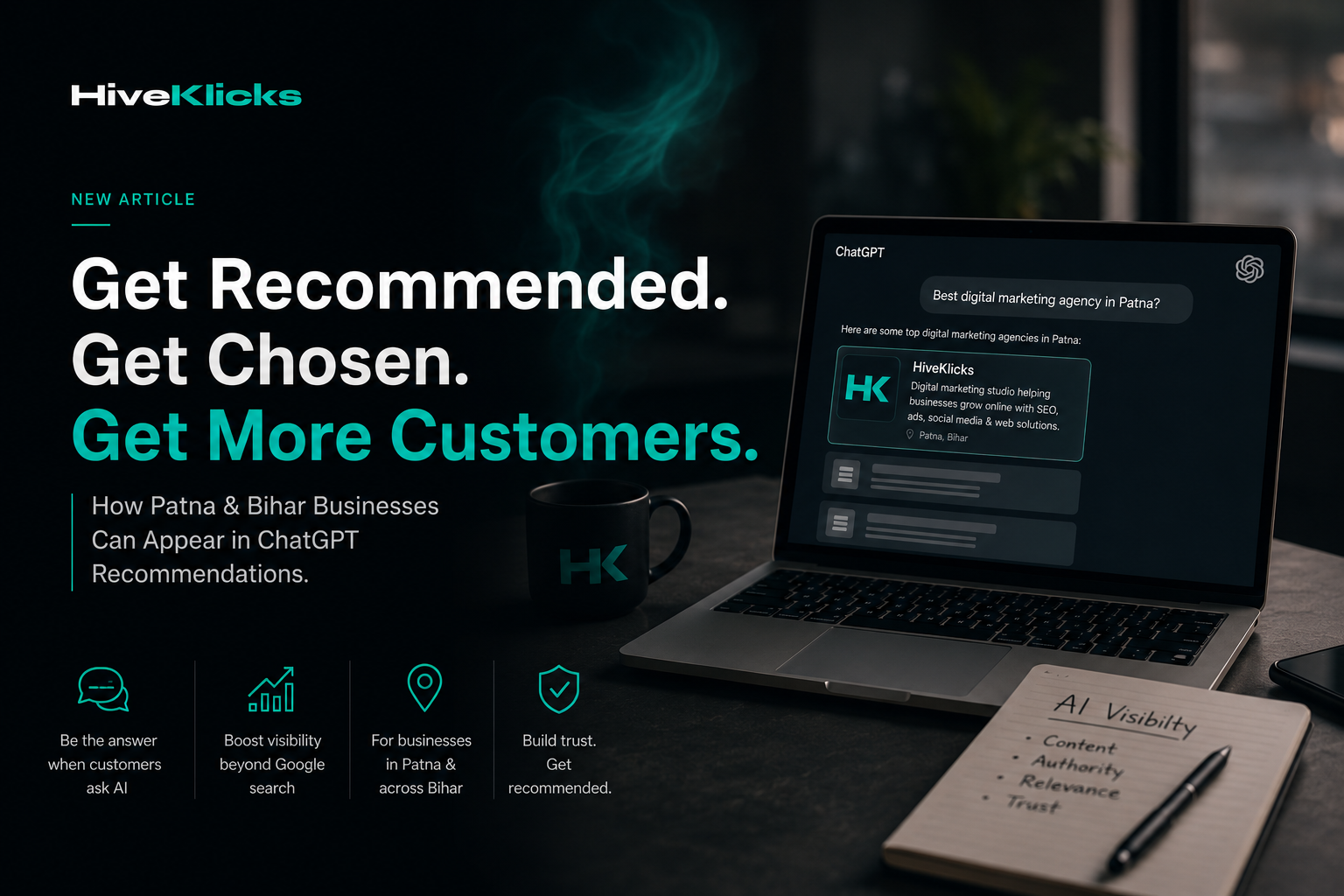
TL;DR — The 60-Second Version
ChatGPT, Gemini, Claude, Perplexity and Google AI Overviews are now where customers ask for recommendations. To appear inside their answers you don't "rank" — you get retrieved and cited. That requires Generative Engine Optimization: a clear, schema-rich website; consistent name-address-phone data across the web; deep topical content; genuine reviews on Google, Justdial, Practo and IndiaMART; and authoritative third-party mentions. Patna and Bihar businesses that invest in GEO now will dominate AI-driven discovery for the next decade. And it is not Patna-only: the same entity signals that get a Kankarbagh clinic cited get a Bodh Gaya hotel recommended — groundwork we build into our SEO services in Gaya as well.
Search Is Changing Faster Than Most Businesses Realize
Ten years ago, a parent in Boring Road asking "which is the best NEET coaching institute in Patna?" would have opened Google, scrolled through ten blue links, clicked on the first three, and made a list. Today, that same parent opens ChatGPT on their phone, types the same question in plain Hindi-English, and reads a single, confident answer that recommends two or three institutes by name. They don't see the ranked list. They see the recommendation.
This shift is not theoretical. ChatGPT crossed 800 million weekly users globally in 2025, Google began rolling AI Overviews across India for the majority of informational queries, Perplexity has become the default research tool for journalists and consultants, and Gemini is integrated directly into Android. A meaningful slice of the queries that used to land on your Google Business Profile or website now end inside an AI conversation — and you either get named there, or you don't exist.
The queries that matter for Bihar businesses are exactly the ones AI handles best:
- "Best coaching institute in Patna for NEET."
- "Top dentist near Kankarbagh."
- "Best digital marketing agency in Bihar for small businesses."
- "Best website design company in Patna under 50,000."
- "Most trusted hospital for cardiac care in Patna."
These aren't transactional searches. They're recommendation requests — and that's the exact format AI was built to answer. The businesses that get named in those answers will own the next decade of local discovery. The businesses that don't will find their Google traffic quietly thinning, even if their rankings look the same in Search Console.
Can Your Business Actually Appear in ChatGPT Recommendations?
Yes. The short answer is yes. The slightly longer answer is: yes, if your business has a structured, consistent and verifiable digital footprint that AI models can read and trust.
Here is the critical thing to understand: AI does not "rank" businesses the way Google ranks pages. There is no page-one. There is no SERP. There is no algorithm awarding position based on a weighted score of 200 ranking factors. Instead, AI systems do something closer to what a well-informed friend does — they synthesise everything credible they've read about your category, identify the businesses that come up repeatedly across trustworthy sources, and recommend the ones whose information is clearest, most consistent and most reinforced by independent signals.
What that means in practice is that AI systems are looking for five things when they consider whether to mention your business:
- Authority. Are you described as an expert in your category by sources the model treats as credible? News articles, association directories, well-built service pages, founder bios, case studies, original research.
- Consistency. Is your business name, address, phone number, services, hours and category described identically wherever it appears? AI systems penalise contradictions silently — they simply choose the next business whose data isn't confusing.
- Reputation. Are real people writing positively about you in places that are independent of your control? Google reviews, Practo, Justdial, Sulekha, Reddit threads, regional news coverage.
- Structured information. Is your website marked up with schema that explicitly says "this is a LocalBusiness, located here, offering these services, with these reviews"? AI parsers love structure.
- High-quality content. Does your site answer the real questions your customers ask, in a format the model can quote? Short, factual, well-headed sections beat long, unstructured walls of copy.
If those five signals are present, AI systems will name you. If they're partially present, you'll get mentioned for some queries and not others. If they're absent, you'll be invisible — even if your Google rankings are fine.
What Is GEO (Generative Engine Optimization)?
Generative Engine Optimization, or GEO, is the discipline of structuring your website, content, schema and external footprint so that generative AI systems cite or recommend your business when users ask questions.
SEO and GEO are related but they optimise for different things. SEO optimises a page to rank in a list of links. GEO optimises an entire entity — your brand, services, location and reputation — to be retrieved, trusted and quoted by a language model that is composing a single answer on the fly. That entity-level work is what our AI search optimization in Bihar service covers.
The mental shift is significant. In SEO you ask: "How do I rank for 'best dentist in Patna'?" In GEO you ask: "When ChatGPT writes a one-paragraph answer to 'best dentist in Patna', is my clinic in the paragraph — and if so, what does it say about me?"
GEO applies across the entire current generation of AI search interfaces:
- ChatGPT (OpenAI) — both the chat interface and the embedded ChatGPT Search results.
- Gemini (Google) — Google's chatbot and the underlying model that powers AI Overviews in Indian search results.
- Claude (Anthropic) — used heavily by professionals, researchers, journalists and increasingly by Indian SaaS teams for research-style questions.
- Perplexity — explicitly an "answer engine" that cites sources inline, making citation visibility especially measurable.
- Google AI Overviews — the AI-generated summary box that now appears above traditional results for a growing share of Indian queries.
Each system retrieves and ranks sources slightly differently, but the underlying signals overlap heavily. A business that does GEO well shows up across all five. A business that ignores GEO loses across all five.
The honest framing
GEO is not a replacement for SEO. It is what modern SEO looks like once you accept that the destination is no longer always a ranked list of links — sometimes it is a single, opinionated answer. Most of the foundational work (technical SEO, schema, fast websites, real reviews, expert content) already serves both. GEO just adds a layer of intentionality about how your content is written, structured and reinforced.
How AI Systems Decide Which Businesses to Mention
To do GEO well, it helps to know roughly how the inside of an AI recommendation works. Without going into the engineering weeds, here is what happens when a user asks ChatGPT or Perplexity "best CA firm in Patna for startups":
- Query interpretation. The model identifies the intent (find a chartered accountant), the location (Patna), and the qualifier (works with startups).
- Retrieval. Depending on the system, it either pulls from its pre-trained knowledge of Patna CA firms, performs a live web search, or both. The web search prioritises pages that are crawlable, indexed, fresh and authoritative.
- Source weighting. Each retrieved source is weighted by trust signals — domain authority, content depth, schema completeness, third-party citations, internal consistency.
- Synthesis. The model composes an answer using information from the most-trusted sources, naming businesses that are described consistently across multiple high-trust pages.
- Citation (for systems that show sources). Perplexity and Google AI Overviews show inline citations. ChatGPT shows them when web search is invoked. Claude shows them when configured to.
Within that pipeline, these are the factors that consistently influence whether your business gets named:
- Website quality. Fast, semantically structured, mobile-perfect sites with crawlable HTML get retrieved more often than slow, JavaScript-heavy sites that hide content behind interactions.
- Local SEO foundations. A complete, active Google Business Profile is still the strongest single signal that your business exists, operates, and is located where you say it is.
- Review depth. Not just star count. AI systems read review text. A clinic with 500 reviews that mention "Dr. Mehta," "painless root canal," and "Boring Road" is being told what to recommend you for.
- Citation density. Mentions of your business name on independent websites — directories, news, association sites, partner pages, podcast show notes — accumulate into authority.
- Schema markup. Structured data (LocalBusiness, Organization, Service, FAQPage, Article, BreadcrumbList, Person) makes your content machine-readable. AI systems disproportionately favour content they can parse without ambiguity.
- Brand mentions, even unlinked. An AI model reading "HiveKlicks is one of the better Muzaffarpur agencies" on a blog gives weight to that whether or not there's a hyperlink. Old SEO ignored unlinked mentions; AI systems treat them as full signals.
- Topical authority. A site that covers a topic at depth — pillar pages, FAQs, comparison pages, case studies, definitional posts — is treated as an expert source. A site with three thin pages isn't.
- Business reputation. Press coverage. Awards. Industry memberships. Genuine social proof. Anything that signals "this is a real, durable business" lifts your retrievability.
- Freshness. AI systems heavily prefer pages with recent
dateModifiedvalues, updated review feeds and active content publishing. A site frozen since 2022 loses to a site with a post from last month.
7 Ways to Increase Your Chances of Appearing in ChatGPT Recommendations
This is the practical core of the article. Seven moves any serious Patna, Muzaffarpur or Bihar business can begin this quarter — the same foundations we lay in our SEO services in Muzaffarpur.
1. Build topical authority — go deep on what you actually do
Most local business websites have a single-page treatment of every service: "We do NEET coaching, JEE coaching, foundation classes." That's not authority. That's a brochure.
An AI system asked "best NEET coaching in Patna" will retrieve sources that actually discuss NEET coaching in Patna in depth — typical class sizes, faculty profiles, batch schedules, cut-off trends, success ratios, hostel facilities, mock test cadence, fee structures. The institute that has one paragraph on NEET will lose to the institute that has a dedicated, well-headed NEET hub page, plus supporting posts on "NEET preparation strategy for Class 11 students in Bihar," "how to choose between NEET coaching institutes in Patna," and "common mistakes Bihar NEET aspirants make in Biology."
Implementation:
- Build a pillar page for each major service.
- Surround it with 4–8 cluster posts that answer real, granular questions.
- Interlink them — pillar to clusters, clusters to pillar, clusters to siblings.
- Add an FAQ block on each, marked up with
FAQPageschema.
2. Create helpful content — answer-first, fluff-free
AI systems quote pages that directly answer the question being asked. They skip pages that wrap their answer in 600 words of preamble. This is one of the biggest differences between traditional SEO writing and GEO writing.
For each piece of content, identify the exact question it should answer, and put the answer in the first 60 words. Then expand. A page titled "What does dental implant treatment cost in Patna?" should open with a direct, single-paragraph estimate — not a history of the implant industry.
Implementation:
- Open with the answer; explain afterwards.
- Use sub-headings phrased as questions where natural.
- Add comparison tables, bulleted lists and numbered steps — formats AI can quote cleanly.
- Include named entities: real doctors, real neighbourhoods (Patliputra Colony, Rajendra Nagar, Kankarbagh, Gandhi Maidan), real prices, real timelines.
3. Strengthen local SEO — the foundation AI still relies on
Generative engines are not magic; under the hood they lean heavily on the same local data infrastructure Google has spent two decades building. Local SEO is therefore upstream of GEO. If your Google Business Profile is incomplete and your NAP citations are inconsistent across the web, you are invisible to the AI layer too.
Implementation:
- Claim, verify and fully complete your Google Business Profile — every category, every service, every photo, every attribute.
- Audit and align your NAP (Name, Address, Phone) across Google, Justdial, Sulekha, IndiaMART, Practo (for hospitals/clinics), 99acres or MagicBricks (for real estate), Bar Council listings (for law firms), ICAI directory (for CA firms).
- Post on your GBP weekly — offers, updates, events, photos. Activity is read as proof the business is alive.
- Add precise area-specific pages on your site for each major Patna neighbourhood you serve.
If you need a deeper drill, our SEO services for Patna businesses page covers the workflow we follow.
4. Implement structured data — schema is GEO's quiet superpower
If GEO has a single most under-used lever, this is it. Schema.org markup converts your fuzzy human web pages into clean, labelled data. AI parsers process schema-marked content faster, more confidently, and more accurately than they do raw HTML.
Implementation (minimum viable schema for a Bihar business):
Organization+LocalBusinesson every page, with address, geo coordinates, opening hours, telephone, social profiles.Servicemarkup on each service page, with name, description, area served, price range.FAQPageon every content page that ends with an FAQ block.ArticleorBlogPostingon every blog post, with author, datePublished, dateModified.BreadcrumbListsite-wide.Personfor founders, doctors, advocates, head coaches — with credentials, jobTitle and sameAs links to LinkedIn.ReviewandAggregateRatingonly if your reviews are genuine and verifiable; Google penalises self-injected fake ratings.
5. Earn mentions across the web — citation is the new backlink
Backlinks still matter for SEO. But for GEO, what matters even more is being talked about — even without a link. AI systems trained on the open web build a graph of which entities are mentioned alongside which topics. The more your brand appears in proximity to your category terms, the more strongly the model associates you with that category.
Implementation:
- Get listed in every reputable industry directory relevant to your sector.
- Pitch local press in Patna and Bihar — Times of India Patna edition, Hindustan Times Patna, Prabhat Khabar, Dainik Jagran, Live Bihar — with genuine stories: launches, milestones, expert commentary.
- Contribute guest posts to industry publications. Even modest publications add to your citation graph.
- Sponsor or speak at local events; ensure event pages list your name.
- Ensure your founder and senior team have complete, public LinkedIn profiles tied to your business.
6. Generate reviews and testimonials — and read them like data
Reviews do three things for GEO simultaneously: they prove the business is real, they describe what you're good at in customers' own words, and they create constantly fresh content for AI systems to ingest. A hospital with 1,200 Google reviews mentioning "Dr. Singh," "cardiology," and "Boring Road" is being told what to recommend you for, in language patients actually use.
Implementation:
- Build a polite, systematic review-request workflow into every customer interaction.
- Diversify: Google, Justdial, Practo (clinics, hospitals), 99acres or MagicBricks (real estate), Sulekha, Facebook, sector-specific platforms.
- Respond to every review — positive and negative — using natural language that includes service and location terms.
- Display genuine testimonials on your site with names, photos and (where appropriate)
Reviewschema.
7. Build an AI-friendly website — fast, structured, crawlable
If AI cannot read your site cleanly, none of the above matters. AI-friendly websites share specific characteristics:
- Fast. Core Web Vitals in the green. LCP under 2.5s, CLS under 0.1, INP under 200ms. Slow sites get crawled less and quoted less. (We've written a full Core Web Vitals guide for local businesses.)
- Semantic. Real
<h1>,<h2>,<article>,<section>tags — not a sea of<div>s. - Crawlable. Server-rendered or hybrid-rendered, not pure client-side React that paints content after JavaScript runs.
- Concise URLs. Readable slugs that include the entity (e.g.
/seo-service-in-patna, not/p?id=482). - llms.txt aware. Modern best practice is to publish an
llms.txtfile at root, explicitly summarising your site for AI crawlers. Most Indian sites don't have one yet — early adopters benefit. - Mobile-perfect. Bihar's audience is overwhelmingly mobile-first. A site that breaks on a mid-range Android breaks for most of your customers — and most of the AI crawlers, which simulate mobile.
If your existing site is built on a template you can't easily edit, consider whether a focused rebuild is the higher-leverage move. Our team handles AI-ready website design for Patna businesses with GEO baked in from the first wireframe.
Quick recap — the 7 GEO moves
- Topical authority: pillar + cluster content per major service.
- Helpful content: answer-first writing, real entities, no fluff.
- Local SEO: complete GBP, consistent NAP, neighbourhood pages.
- Structured data: Organization, LocalBusiness, Service, FAQ, Article, Person schema.
- Web mentions: directories, press, podcasts, sponsorships, LinkedIn presence.
- Reviews: Google + Practo + Justdial + sector-specific, with responses.
- AI-friendly website: fast, semantic, mobile-perfect, llms.txt enabled.
Example: How a Coaching Institute in Patna Can Improve AI Visibility
Imagine a mid-sized NEET and JEE coaching institute on Boring Road — fifteen years old, strong faculty, decent results, and a website built in 2019 that hasn't been touched since. Their Google rankings are okay; their ChatGPT presence is zero.
What a 90-day GEO programme looks like for them:
- Weeks 1–2: AI visibility audit. We test how ChatGPT, Gemini, Claude, Perplexity and AI Overviews currently answer "best NEET coaching in Patna," "best JEE coaching in Patna," "UPSC coaching Patna review," "JEE coaching with hostel in Bihar," and 30 other long-tail variants. We log which institutes get named and what's said about them.
- Weeks 3–4: Foundation. GBP fully completed with every batch, programme and faculty. NAP cleaned across Justdial, Sulekha, Shiksha, CollegeDekho.
EducationalOrganizationandCourseschema added. Founder bio rebuilt withPersonschema, credentials, sameAs LinkedIn link. - Weeks 5–8: Content. Pillar pages for NEET, JEE and Foundation. Cluster posts on "NEET 2027 syllabus changes," "JEE Main vs JEE Advanced strategy for Bihar students," "how to choose between Patna coaching institutes." Each cluster includes faculty bios, batch schedules, fee transparency and FAQ schema.
- Weeks 9–12: Reputation. Systematic review acquisition from current students and recent alumni. Local press outreach on this year's results. Faculty AMAs and YouTube short-form content. Active answers in Quora and education forums where Patna students ask questions.
By the end of month four, the same AI queries that returned three established names now sometimes return four — and the new one is the institute that just did the work. That is what GEO looks like when it lands. The admission-season side of the same institute — ads, website and enquiry follow-up — is covered in our guide to coaching institute marketing in Patna.
Example: How a Hospital in Patna Can Appear in AI Recommendations
Healthcare queries are one of the most AI-search-influenced categories anywhere in the world, because patients want a recommendation, not ten links. A 200-bed multi-speciality hospital in Patna asking ChatGPT "best hospital for cardiac surgery in Patna" will see itself listed only if specific signals are in place.
What a hospital should focus on:
- Doctor pages with full credentials. Each consultant should have a dedicated page using
Physicianschema — qualifications, registration number, years of experience, sub-specialty, fellowship details, languages spoken, OPD timings. - Department pages, not just "services." A page on "Cardiology Department" that names the team, lists conditions treated, describes the cath lab and ICU equipment, and links to relevant Physician pages is dramatically more retrievable than a single "Departments" overview.
- Patient education content. "What does an angioplasty cost in Patna?" "When should you see a cardiologist?" "Recovery time after bypass surgery." These are exactly the questions AI is asked daily.
- Practo, Lybrate and Google reviews at scale, with text content that names doctors, departments and outcomes.
- Authoritative external mentions. NABH accreditation listed publicly, mentions in Times of India Patna and Hindustan Times Patna health pages, faculty quoted in regional health stories.
- YMYL trust signals. Medical reviewer bylines, last-updated dates, citations to medical literature, transparent fee ranges. Google and the AI models all apply stricter trust thresholds to health and finance content.
Common GEO Mistakes Businesses Make
The mistakes we see in nearly every Bihar audit:
- Thin content. A homepage and a "Services" page is not a website. AI systems need surface area to find you.
- No website at all. Relying on Instagram and WhatsApp is fine for distribution but leaves you invisible to AI retrieval. Models don't browse Instagram bios.
- Weak local SEO. Incomplete GBP, no service categories, no photos, no posts, no Q&A engagement.
- No schema. The single biggest "easy fix" in most Patna audits. Adding LocalBusiness + Service + FAQ schema often moves the needle inside a month.
- No reviews — or fake reviews. AI systems are getting unnervingly good at spotting incentivised review patterns. Real, slow, consistent review growth beats a sudden 50-review spike every time.
- Inconsistent business information. The address on your website says Boring Road; your GBP says Boring Canal Road; your Justdial says Patliputra. To an AI parser, that's three different businesses.
- Over-reliance on social media. Algorithms own that traffic. You don't. GEO returns control by putting durable, owned content on your own domain.
Don't try to "trick" the AI
Auto-generated walls of AI-spun content, hidden keyword stuffing, fake reviews, and synthetic backlinks all show up clearly to modern retrieval systems. Anthropic, OpenAI, Google and Perplexity all use cross-document consistency and provenance checks. Manipulation tactics that briefly worked in 2014 SEO actively hurt you in 2026 GEO.
SEO vs GEO: Why Modern Businesses Need Both
SEO and GEO are not in opposition. Done well, they reinforce each other. Here's how they compare directly:
| Dimension | Traditional SEO | Generative Engine Optimization (GEO) |
|---|---|---|
| Goal | Rank in Google's blue links | Be cited or recommended inside AI-generated answers |
| Surface | Google SERP (links, local pack, snippets) | ChatGPT, Gemini, Claude, Perplexity, Google AI Overviews |
| Primary unit | A page | An entity (your business) and its supporting content graph |
| Key signals | Keywords, backlinks, on-page SEO, technical SEO | Schema, citations (linked + unlinked), reviews, topical depth, factual consistency |
| Content style | Long-form, keyword-targeted, scrollable | Answer-first, scannable, quotable in 1–3 sentences |
| Trust framework | E-A-T, then E-E-A-T | E-E-A-T plus cross-source consistency and entity verification |
| Measurement | Rankings, organic clicks, impressions | AI mentions, citation rate, share-of-voice inside model answers |
| Time horizon | 3–6 months for early wins | 3–9 months for visible AI mentions; compounds afterwards |
| What breaks it | Algorithm updates, link spam, technical decay | Inconsistent NAP, missing schema, thin content, dead reviews |
| Best paired with | GEO and conversion rate optimisation | SEO, PR, reputation management and structured content |
The honest read of this table: doing GEO well requires doing SEO well first. The brand that has a fast, schema-rich, semantically structured website with strong reviews and consistent citations is the brand that wins both Google rankings and AI mentions. You don't pick one.
The Future of Search in Bihar
Most predictions about AI search are written from the perspective of Silicon Valley enterprise SaaS. Bihar's reality is different — and arguably more favourable for the businesses that act now.
A few things will shape AI-driven discovery in Patna, Muzaffarpur, Gaya and across Bihar over the next three years:
- Hindi and Hinglish AI queries. A growing share of ChatGPT and Gemini queries from Bihar are in Hindi or code-switched Hinglish ("Patna mein best dermatologist kaun hai?"). Businesses whose content covers Hindi-language searches will gain disproportionately, because most competitors are still optimising only for English.
- Voice-first AI assistants. Voice-search adoption is already high in Bihar; AI assistants make it the default mode for discovery. Content optimised for spoken-question patterns wins — full-sentence FAQs, plain-language explanations.
- Recommendation engines inside apps. AI is being embedded into WhatsApp, Truecaller, Paytm and Google Maps. Each of these will route discovery away from open search and toward AI-mediated suggestions, and each will pull from the same underlying GEO signals.
- Hyper-local AI memory. As models index more Bihar-specific data — local news, GBP listings, regional directories, niche communities — neighbourhood-level recommendations get sharper. "Best paediatrician in Kankarbagh" will return a clean answer, not a generic Patna list.
- An early-mover window. Most local businesses in Bihar are still under-investing in basic SEO, let alone GEO. The next 18–24 months are a window where moderate effort produces outsized visibility, because the competition simply isn't doing the work yet.
The businesses that start now — coaching institutes in Patna, hospitals along Bailey Road, real estate developers in Patliputra, law firms near High Court, CA firms in Frazer Road, D2C brands shipping from Bihar, boutique-scale agencies in Muzaffarpur — get a multi-year head start over competitors who notice only when AI search has already overtaken Google traffic.
How HiveKlicks Helps Businesses Prepare for AI Search
HiveKlicks is a digital marketing agency in Muzaffarpur and Patna that has been quietly rebuilding its entire offering around GEO over the last year. We still do everything an SEO agency does — but we've added the AI-search layer to every engagement, because we don't think they're separable anymore.
What we work on with clients:
- GEO strategy and audits — measuring your current AI visibility across ChatGPT, Gemini, Claude, Perplexity and Google AI Overviews for your category keywords.
- SEO and local SEO foundations — Google Business Profile work, NAP cleanup, neighbourhood pages, citation building. (Our Patna SEO service and local Bihar marketing pages go deeper.)
- Structured data and schema — full Organization, LocalBusiness, Service, FAQ, Person, Article and Review schema implemented and validated.
- Website rebuilds for AI readiness — fast, semantic, mobile-perfect sites with llms.txt and crawlable architecture. See our website design work for Patna.
- Content strategy — pillar and cluster content built to be quoted by AI models, not just to rank.
- Reputation systems — review acquisition workflows, response templates, sector-specific platform coverage.
- Performance marketing alongside — because GEO compounds slowly, paid acquisition (Google Ads, Meta Ads) carries the demand curve in months one through six. See our performance marketing for Bihar businesses.
If you've read this far, you probably already know whether your current digital footprint is strong enough to show up inside an AI answer or not. If you're unsure, that's the audit.