Sooner or later every business owner with a website receives the same message: 500 high-quality backlinks, ₹3,000, delivered in seven days. It arrives by email, on WhatsApp, sometimes from an agency already on the payroll. The offer is tempting because the logic sounds right. Google ranks sites that other sites link to, so more links must mean higher rankings.
The first half of that is true. The second half is where the money is lost.
A backlink is a link from someone else’s website to yours. Google reads it as that site vouching for you, in roughly the way a customer treats a recommendation from a neighbour. And like a recommendation, its worth depends entirely on who is giving it and why. A mention in a local newspaper’s report counts. Five hundred links from websites that exist only to sell links are worth nothing, and Google has spent years learning to tell the two apart.
This guide is about the kind that counts: what a local business in Bihar can publish that other websites have a reason to point to, how to get it noticed, and how few such links it takes to matter.
Which Backlinks Count
Three things decide what a link is worth.
- Someone chose to give it. A reporter, a teacher, an association secretary or another business owner decided your page was worth sending their readers to. Nobody paid them and nobody made it a condition of anything.
- It comes from a site with readers. A page that people visit, on a site that publishes things people want, passes on some of that standing.
- It is relevant. A link from a Bihar education portal to a Muzaffarpur coaching institute makes sense. A link to the same institute from a casino review site in another country does not, and is ignored at best.
It helps to separate backlinks from citations. A citation is a listing of your name, address and phone number on a directory such as Justdial, Sulekha or IndiaMART, or on your Google Business Profile. Citations confirm that you exist and where. They are worth getting right, with identical details everywhere. But every competitor has them too, so they are the entry ticket and not the advantage.
| Where the link comes from | Worth | Why |
|---|---|---|
| A local newspaper or news portal quoting your figures | High | Editorial choice, wide readership, local relevance |
| A college, school or trade association resource page | High | Trusted institution, hard to obtain |
| A supplier or brand listing you as a dealer | Good | Relevant to your trade, and factual |
| Another local business recommending you | Good | Relevant and local |
| A directory listing | Baseline | Confirms your details; everyone has one |
| Blog comments, forum signatures, profile pages | None | Anyone can create them, so they prove nothing |
| A purchased package | None, with some risk | Exists only to manipulate rankings |
Why Most Business Blogs Earn No Links
Open the blog on almost any small business website and you will find posts such as “5 Benefits of Digital Marketing” or “Why Every Business Needs a Website”. They are 500 words long, they say what the first ten results on Google already say, and nobody has ever linked to one.
The reason is simple. People link to a page when they need to refer to it: to back up a claim, to send a reader to a fuller explanation, to credit a source. A summary of common knowledge gives them nothing to refer to.
So before writing anything, ask one question. Is there a person, other than a customer, who would need to point at this page? A journalist who wants a number. A teacher who wants to share a clear explanation. A group admin who wants to answer the same question for the fortieth time by pasting a link. If you cannot name that person, the piece may still be useful to customers, but it will not earn links.
What those people need has one thing in common: it is not available anywhere else. That usually means a fact you collected, a tool you built, or an explanation you are better placed to give than anyone else.
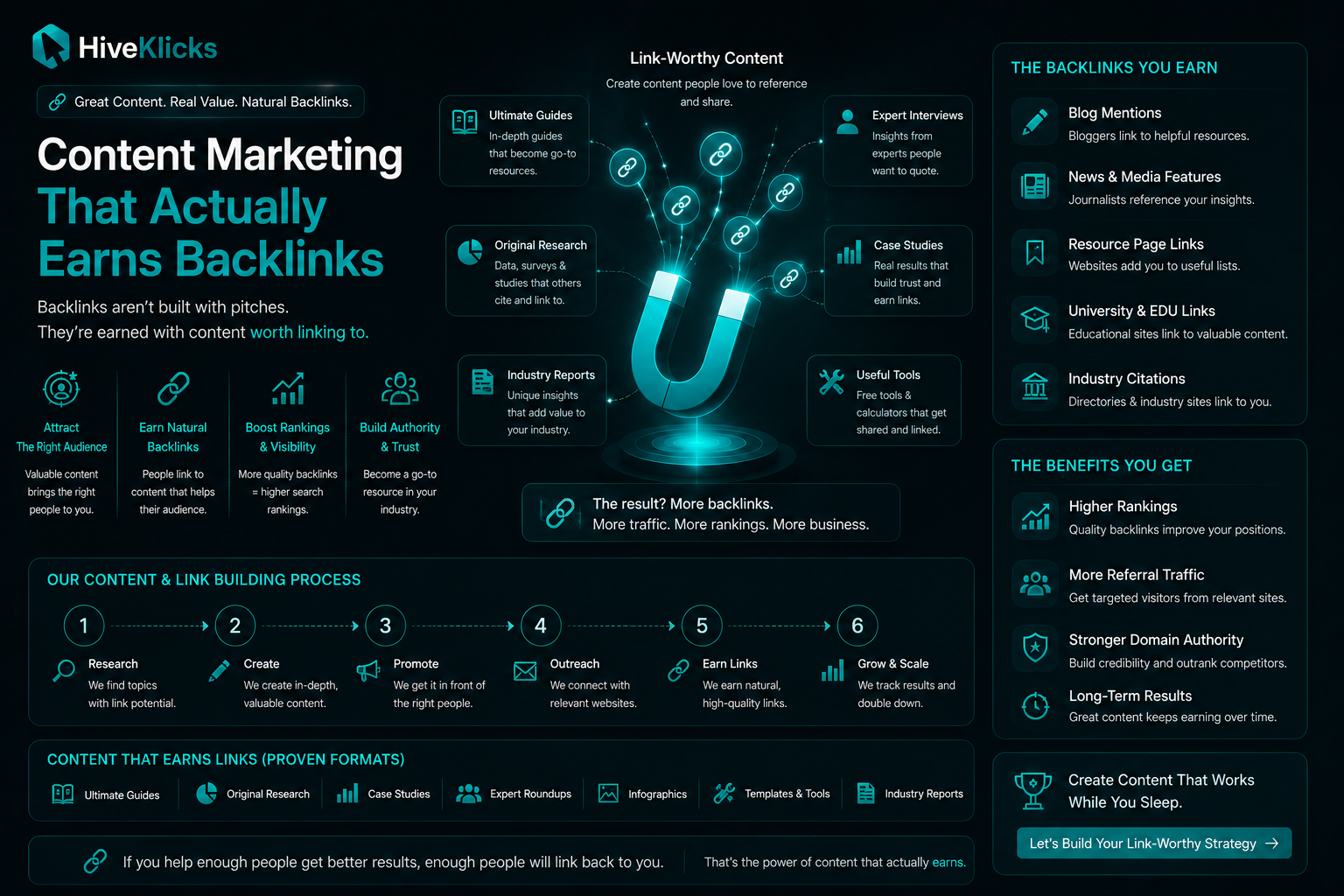
Six Kinds of Content People Link To
Each of these is within reach of an ordinary business. You do not need to do all six. One, done properly, is worth more than twenty blog posts.
Figures nobody else has collected
Reporters on the local editions of Hindustan, Dainik Jagran, Prabhat Khabar and Dainik Bhaskar, and on the city news portals, are always short of local data. You are probably sitting on some. A property dealer knows asking prices per square foot by locality. A diagnostic lab knows which tests rise in which month. A litchi trader knows how this season’s arrival dates compare with last year’s.
Put the figures on one page with a date, say how you gathered them, and keep customer names out. A page titled “Flat prices in Patna by locality, October 2026” gives a reporter something to cite, and a citation is a link.
Calendars and guides tied to an event
Some questions come back every year on a schedule. School admission dates in Muzaffarpur. Wedding muhurat dates for the coming lagan season. What a family should arrange before Pitru Paksha in Gaya. Where to stay and what to carry for the Sonepur Mela.
A boutique, a caterer, a hotel or a school that publishes the clearest version of one of these becomes the page that gets forwarded in family groups and linked from local sites each year. Keep it at the same address and update it annually, so the links build up on one page.
A calculator or checker that saves someone time
A tool gets linked because describing the answer is harder than pointing at the thing that produces it. A hardware store can offer a tile and paint quantity calculator. A coaching institute can offer a rank or percentile estimator. A property consultant can offer a stamp duty and registration cost calculator for Bihar, kept up to date.
Our own free website audit is an example: it answers a question people have about their own site, at no cost, and that makes it something worth sharing.
The definitive local answer to a practical question
How to check whether a housing project is registered with Bihar RERA. What a home baker in Patna needs for FSSAI registration. How to get a trade licence from the municipal corporation. These are questions with a correct answer that is surprisingly hard to find in one place, in plain language.
If your trade puts you close to the process, write it up step by step, link to the official source for each step, and date it. Pages like this are linked from forums and from accountants’ and consultants’ sites. They are also the kind of clear, sourced page that AI assistants draw on when they answer the same question, which we look at in how ChatGPT picks businesses to recommend.
Original photographs and visuals
Local news sites, bloggers and students are permanently short of good pictures of their own city. A well-shot set of a market, a festival or a landmark, published with a line saying it is free to use with credit and a link, will be used. The same goes for a clear map or a simple chart made from your own figures.
Stories with a named person in them
An interview with a respected principal, a senior doctor, or the third-generation owner of a well-known shop gets shared by that person and often linked from their institution’s site. A case study works the same way, provided the customer is named with permission and the figures are specific.
Publishing Is Half the Job
A useful page that nobody knows about earns nothing. The other half of the work is making sure the people who might refer to it have seen it. That step is the one most often skipped.
Before publishing, write down twenty people who would have a reason to care. For a dated guide or a set of local figures, the list usually includes:
- reporters who cover your trade or your city for the local editions and portals;
- admins of the large local Facebook groups and Instagram pages;
- whoever maintains the website of the relevant school, college or association;
- your suppliers and the brands you stock;
- businesses that serve the same customers without competing with you.
Then send each of them a short, individual message. Say what you have published, give one specific finding from it, and explain why their readers would want it. Keep it to four or five lines, attach nothing, and do not ask for a link. People link when the page is useful to them; asking tends to make them less likely to.
Follow up once after a week. Of twenty messages, expect a few replies and one or two links. That is a good result. Two links from a local newspaper and a college are worth more than anything in a purchased package.
Links You Are Already Owed
Before creating anything new, collect the links your existing relationships entitle you to. Most businesses have several waiting.
A short list to work through this week
- Brands you are an authorised dealer for. Most have a dealer or store locator page. Ask to be listed, with a link.
- Suppliers and service partners. A “where to buy” or “our clients” page is a natural home for your name.
- Associations and chambers you belong to. Member directories usually allow a website address.
- Events you have sponsored. Sponsors are normally listed on the event or organiser’s site.
- Hospitals, insurers or institutions you are empanelled with. Panel lists are public pages.
- Any press coverage you have had. If an article names you without linking, a polite note to the desk often fixes it.
What Not to Do
Google publishes its spam policies, and they are clear on this point: links created mainly to manipulate rankings are link spam. Its systems are designed to ignore such links, and in persistent cases a site can receive a manual action that suppresses it in search until the links are dealt with.
| What you are offered | What it is |
|---|---|
| “500 backlinks in 7 days” | Automated links on abandoned sites, comment sections and profile pages |
| “Guest posts on DA 50+ sites, ₹500 each” | Paid placement on sites that publish anything for a fee |
| “Submission to 200 directories” | Listings on directories no person has ever browsed |
| “Link exchange network” | Sites linking to each other in rotation, which is a pattern Google detects easily |
| “Private blog network” | A set of fake sites built to pass links, and a common cause of manual actions |
Two terms come up in these pitches. DA and DR (Domain Authority and Domain Rating) are scores invented by companies that sell SEO software. They are their estimates, they are not used by Google, and they can be inflated by exactly the kind of links being sold. A rising DA proves only that someone bought links.
Paying for exposure is not forbidden. Advertising, sponsored articles and paid listings are ordinary business. The rule is that a paid link should be marked as sponsored, which tells Google not to count it as a recommendation. You are paying for the readers it sends you, and that can be well worth it.
How Many Links Does a Local Business Need?
Fewer than you have been told. You are not competing with national brands. You are competing with the handful of businesses that appear for your search in your city, and many of them have no editorial links at all.
Search for your main term, look at who holds the first few places, and consider what stands behind them. In most local categories in Bihar you will find directory listings, a Google Business Profile with reviews, and little else. Against that field, three or four links from a newspaper, a college and a pair of suppliers set a site apart.
Links also do a second job for a newer website. Google is cautious with a domain nothing else points to; it may take a long time to index the inner pages, and longer to trust them. A few links from established local sites are often what moves a young site from being crawled now and then to being taken seriously.
A Twelve-Week Plan
- Weeks 1 and 2: get the base right. Make your name, address and phone number identical on your website, your Google Business Profile and the main directories. Check that the pages you want to rank exist and are worth landing on. Our local SEO playbook for Bihar shops covers this stage.
- Weeks 3 and 4: collect what you are owed. Work through the dealer pages, associations, sponsors and past press on the list above.
- Weeks 5 to 8: build one reference piece. Choose the type that suits what you know. Give it a clear title, a date, your sources and a plain layout that loads quickly on a phone.
- Weeks 9 and 10: tell twenty people. Send the individual messages and follow up once.
- Weeks 11 and 12: record and connect. Note which sites linked. Inside the piece, link to the service pages it relates to, so visitors and search engines arriving at the article are led to what you sell.
Then repeat with a second piece next quarter. Four reference pieces a year, each earning a few links, will put most local businesses ahead of everyone they compete with.
How to Know It Is Working
Ignore DA. Watch these four, all free.
- Linking sites in Google Search Console. The Links report lists the sites that link to you. The count of different sites matters more than the total number of links.
- Visitors arriving from those links. A link that sends people is doing its job even before it affects ranking.
- Pages indexed. On a newer site, more of your pages appearing in Google is often the first visible effect.
- Position for the terms you care about. Check monthly, not daily. Movement from links is gradual.
Links are one part of being found. The page they point to still has to deserve its place, and the reasons a business fails to appear are often simpler than a lack of links, as we set out in why most local businesses stay invisible on Google. Earning links alongside on-page work and Google Business Profile management is part of our SEO services in Muzaffarpur, SEO services in Patna and SEO services in Gaya, from ₹2,499 a month.
Not Sure What Your Business Could Publish?
Tell us what you sell and where. On a short call we will suggest two or three reference pieces that suit your trade and name the kinds of sites likely to link to them. If your website needs work before any of that is worth doing, we will say so.
Book a Free Strategy Call →