Every month, business owners across Muzaffarpur, Patna and the rest of Bihar open a marketing report and read some version of the same paragraph. Reach: 41,300. Impressions up 38 per cent. Followers: +212. Website traffic up 24 per cent.
The owner reads it. Says thank you. Closes the file. And then sits with the only question they actually had, still unanswered: did any of that bring me customers?
That gap is not usually dishonesty. It is a habit. The numbers that are easiest to produce are not the numbers that help anyone decide anything, and once a reporting format exists, it tends to survive long after it has stopped being useful. Meanwhile the owner keeps funding the work on instinct, which is an expensive way to make decisions.
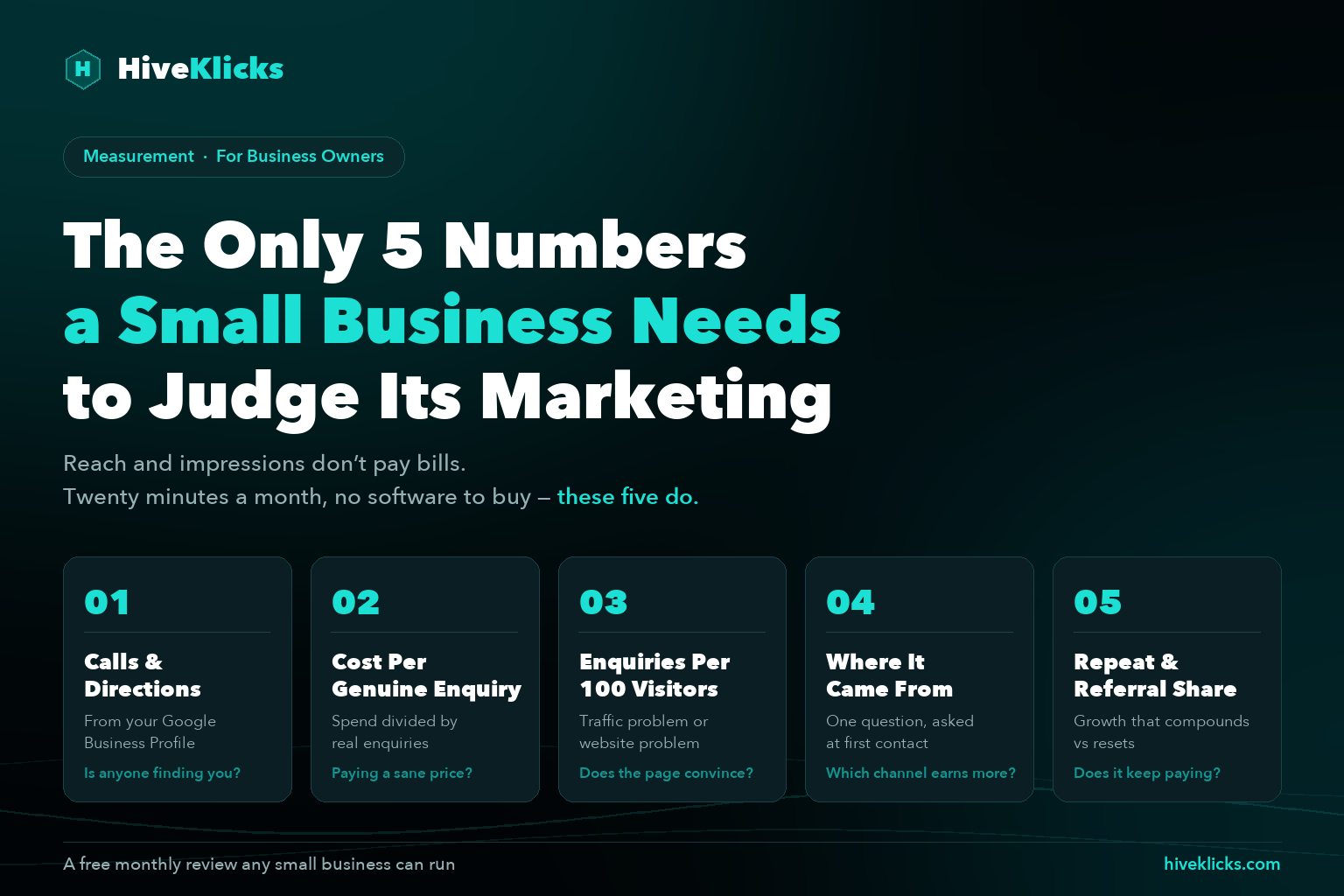
This article proposes something narrower and more useful: five numbers. Not a dashboard, not a tool subscription, not a data analyst. Five numbers you can collect yourself, four of them free, one of them requiring nothing more than a question and a notebook. If those five are healthy, your marketing is working, whatever the reach says. If they are not, no amount of impressions will save it.
Why the Wrong Numbers Survive So Long
Vanity metrics are not a conspiracy. They persist for three ordinary reasons.
They are easy to grow. Reach responds to posting more often, to boosting a post for a few hundred rupees, to one reel catching a wave. None of those things necessarily changed your business, but all of them make a chart point upward, and a chart pointing upward feels like progress.
They are always available. Every platform hands you impressions for free. Nobody has to build anything, ask anyone a question, or admit that a month was quiet.
And they are safe. A number that cannot fail is a number that never forces a difficult conversation about whether the money is working. This is the quiet reason vanity metrics outlive everything else on a report.
Compare that with cost per enquiry. It can rise. It can rise badly. And when it does, somebody has to explain why and change something. That discomfort is precisely the value.
The Test a Number Has to Pass
Before the five, here is the filter that produced them. A number earns a place on your report only if it passes all three:
- A decision changes when it moves. If the number doubles and you would do nothing differently on Monday, it is trivia, not measurement.
- It touches money. Either it counts people who asked to buy, or it counts what you paid to get them, or it counts whether they came back.
- You can get it without buying anything. Google gives away every tool a small business needs here. If a number requires a subscription before you have proof the marketing works, it is premature.
Almost everything on a standard agency report fails at least one of those. Reach fails the first. Follower count fails all three. “SEO score” out of 100 fails the first and second, and is usually generated by a tool that sells its own fix.
Number 1 — Calls and Direction Requests From Your Google Business Profile
Start here, because for most local businesses in Bihar this is the closest free thing to a demand meter.
Inside your Google Business Profile, the Performance section reports how many people called you directly from your listing, how many asked for directions to your shop, how many clicked through to your website, and which searches surfaced you in the first place. Every one of those is a person who was looking for something you sell, found you, and acted — not a person who scrolled past a post.
What to write down each month: calls, direction requests, website clicks. Three figures. That is the whole exercise.
What it tells you: whether you are being found at all. If calls are flat for months while you keep posting on Instagram, the problem is discovery, not content — and discovery is a different job, which we have broken down in detail in why most Muzaffarpur businesses stay invisible on Google and in the local SEO playbook for Bihar shops.
What it does not tell you: quality. A profile can generate plenty of calls from people asking for something you do not sell, which is usually a sign the categories or photos on your listing are describing the wrong business.
One practical warning: Google keeps only a limited window of this performance history. Note the monthly figures somewhere of your own — a spreadsheet, a page in a diary — or in a year you will have no way of proving to yourself what changed.
Number 2 — Cost Per Genuine Enquiry
This is the number that decides your budget, and the one most often replaced by a softer substitute.
The formula is unremarkable:
Total spent in the month ÷ number of genuine enquiries = cost per genuine enquiry
The entire weight of it sits on the word genuine. A genuine enquiry is a human being who contacted you wanting to buy something you actually sell. It is not a click. It is not a form fill from someone who wanted a job. It is not the same person messaging on Instagram, WhatsApp and the contact form, counted three times. Platforms report leads generously, because generous numbers make platforms look effective.
“Total spent” means everything: ad budget plus whatever you pay for management. An agency fee excluded from the calculation is an agency fee nobody is judging.
Reading it: the comparison that matters is against your own previous months, and against what one closed customer is worth to you. A saree boutique with a fifteen hundred rupee average sale and a school charging annual fees cannot use the same target, so borrowed benchmarks are close to meaningless. What is meaningful: if your cost per genuine enquiry approaches the profit on an average sale, the campaign is not a growth engine, it is a treadmill.
This is also the number that exposes ad problems fastest. Rising cost per enquiry with steady spend usually means targeting, offer or landing page — the three failure points we walk through in why Google Ads in Bihar often fail to convert. Watch it weekly while a campaign is live; monthly is fine once it settles.
Number 3 — Enquiries Per 100 Website Visitors
Traffic on its own is a vanity metric wearing a serious face. It becomes genuinely diagnostic the moment you divide by it.
A site with 300 visitors and 12 enquiries is in better health than a site with 3,000 visitors and 9. The first has a discovery problem, which is solvable with time and content. The second has a persuasion problem, which no amount of extra traffic will fix — every additional visitor simply arrives, fails to be convinced, and leaves.
That is the real power of this number. It separates the two failures that look identical from the outside:
- Low traffic, decent conversion rate: the site works, not enough people see it. Invest in visibility — search, listings, content.
- Good traffic, poor conversion rate: people see it and are not convinced. Invest in the page — clarity above the fold, a visible phone number, proof, speed.
- Low traffic, poor conversion rate: fix the page first. Sending more people to a page that does not convince is the most expensive mistake on this list.
As a rough orientation only: local service websites we look at tend to land somewhere in the low single digits of enquiries per 100 visitors. Treat that as a hypothesis about your own site rather than a target — the honest benchmark is last quarter's version of you.
Two things move this number more than anything else, and neither is copywriting. The first is speed on a mid-range Android on a patchy connection, which is how most of your customers will actually meet you — covered in fixing slow sites and recovering rankings. The second is whether a stranger can tell what you sell, where you are and how to contact you within a few seconds of landing.
Number 4 — Where the Enquiry Actually Came From
This is the number no software will give you, and the one with the highest return for the least effort.
Ask. At the point of contact, in whatever language the customer is comfortable with: aapko humara number kahan se mila? Write the answer down. A register, a notes app, a column in a copy — the medium does not matter.
Analytics cannot see most of how a business in Bihar actually gets found. It cannot see a WhatsApp forward. It cannot see a cousin's recommendation, a hoarding near the crossing, a sticker on an auto, or a customer who saw your reel three weeks ago and searched your name today. Attribution tools guess at these and guess badly, usually crediting whichever channel happened to be last in the chain.
What owners find when they start recording this for even one month is reliably uncomfortable and reliably useful. The channel that produces the most enquiries is often not the channel receiving the most money and attention. Sometimes a modest, unglamorous Google listing is quietly outproducing months of content. Sometimes an entire ad budget turns out to be re-buying customers who would have found you anyway.
You cannot allocate a budget sensibly without this number. Everything else tells you how a channel performed; this tells you which channel deserves the next rupee. It is also the number that makes the other four interpretable, which is why it sits in the middle of the list rather than at the end.
Number 5 — Repeat and Referral Share
The final number decides whether you are building a business or renting one.
Of the customers who bought from you this month, what share had bought before, or arrived because someone told them to? That is your repeat and referral share, and it is the difference between growth that compounds and growth that resets every time you stop paying.
A business with a low share has to buy every single customer, every single month, forever. Its marketing cost never falls. A business with a healthy share buys a customer once and gets paid several times, which is why two shops with identical ad budgets end up in entirely different places after three years.
It is also the number that most directly measures whether the actual work is good, which no other metric on this list touches. Marketing can bring someone through the door once. Only the product, the service and the follow-up bring them back — and no campaign in the world outruns a business people do not want to return to.
Track it as a simple fraction, monthly, from the same register you use for number four. It moves slowly. That is exactly why it is worth watching over a year rather than a week, alongside the industry outcomes and growth scenarios we track for clients.
The Five Together: A Worked Illustration
Numbers in isolation mislead. Here is how they read as a set. The figures below are illustrative — a composite of the pattern we see rather than any one client's account.
A boutique in Muzaffarpur spends 12,000 rupees in a month across ads and management. The month produces:
- GBP: 64 calls, 88 direction requests — both up steadily for three months
- 28 genuine enquiries — roughly 430 rupees per enquiry
- 1,900 website visitors, 21 enquiries from the site — a little over 1 per 100
- Source register: 14 from Google, 9 from Instagram, 4 from referral, 1 from a hoarding
- Repeat and referral share: 18 per cent
A vanity report would call this a good month, and the owner would keep spending. Read as a set, it says something sharper. Demand is real and growing — number one is healthy. Money is not being wasted at the top of the funnel — number two is defensible. But 1,900 visitors producing 21 enquiries is the weak link: the traffic is arriving and leaving unconvinced. Meanwhile Google is producing half the enquiries on a fraction of the attention Instagram receives.
So the correct decision that month is not “spend more.” It is: fix the website's conversion, then move budget toward search. Without the five numbers, the same month reads as “marketing is working, let us increase the budget” — and the extra money goes straight into a page that was already failing to convince people.
The Twenty-Minute Monthly Review
None of this requires a process document. Once a month, on a fixed date:
- Five minutes. Open Google Business Profile, note calls, direction requests, website clicks.
- Five minutes. Add up what you spent, count genuine enquiries, divide.
- Five minutes. Note website visitors and enquiries from the website; divide.
- Five minutes. Tally the source register, and count repeat and referred customers.
Then answer one question in writing: what changes because of this? A review that produces no decision was a report, not a review. If you want the wider version of this discipline — who is responsible for which number, and in what order things get fixed — that is essentially what our seven-step working process is built around.
What to Stop Reporting
Removing numbers is as valuable as adding them, because every metric on a page competes for the same limited attention. These have earned their retirement:
- Reach and impressions. They count exposure, not interest. They rise when you post more, which is not the same as when you sell more.
- Follower count. Followers are an audience you rent from a platform, and the platform decides how many of them ever see you.
- Number of keywords ranked. Ranking for two hundred phrases nobody in your district searches is not visibility. A handful of phrases with buying intent is.
- “SEO score” out of 100. Generated by a tool, sold by whoever runs the tool, and unconnected to whether a customer found you.
- Posts published. A measure of activity, not outcome. It tells you the work happened, not that it mattered.
None of these are lies. They are simply not decisions.
What to Ask Your Agency For
You cannot verify any of the five if you cannot see the accounts. Whether you work with us, with someone else, or with a freelancer, this list belongs to your business and is free:
- Ownership of the ad accounts. Google Ads and Meta accounts should be in your business's name, with your agency granted access — not the other way round. Account history is an asset, and it should not walk out with a vendor.
- Admin on your Google Business Profile. This is your listing. There is no legitimate reason for you not to be an owner of it.
- Your own logins to Search Console and Analytics. Both free. They tell you what people searched before they arrived and what they did after.
- The enquiry log. Not a screenshot of a dashboard — the actual list of who contacted you and what they wanted.
An agency confident in its work hands these over without discussion, because transparent numbers are what makes results provable rather than claimed. It is the same reason we put a starting price on every service page instead of hiding it: a client who can check the numbers is a client who can tell the difference between a good month and a good report.
The Uncomfortable Part
Once you start tracking these five, some months will read badly. That is not a flaw in the method; it is the method working. The alternative — a report where every number always goes up — is not a picture of a healthy business. It is a picture of numbers chosen because they cannot fail.
Almost every owner who starts this discovers at least one uncomfortable thing in the first quarter: a channel that was never producing, a website that was quietly losing people who were ready to buy, or a budget being spent to re-buy customers who already knew them. Finding those out is worth considerably more than a year of reach charts.
Five numbers. Twenty minutes a month. No software to buy.
Want These Five Numbers Read for Your Business?
HiveKlicks is a digital marketing agency in Muzaffarpur working with businesses across Bihar — boutiques, schools, clinics, restaurants, coaching institutes and local service brands. Send us access to your Google Business Profile and website analytics and we will read these five numbers with you honestly, including the parts that are working fine without us.
Book a Free Strategy Call →