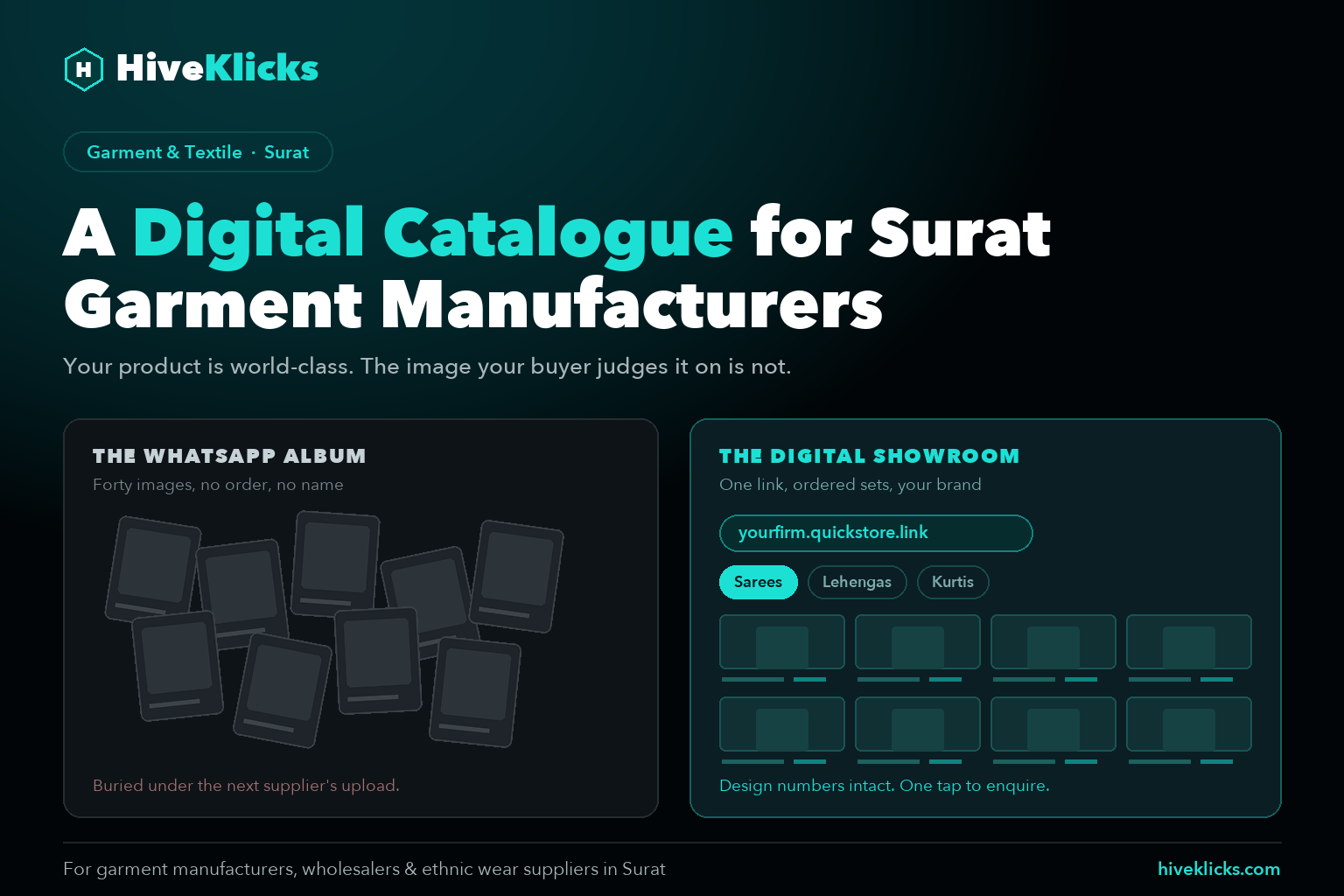
By half past ten on a working morning, the shutters are up across Ring Road. Millennium, New Textile Market, Raghukul, the lanes running down toward Sahara Darwaja — the trolleys start moving, the tea arrives, the first agents walk in with buyers from out of state.
But the day's real selling started two hours earlier, and it didn't happen in any of those markets.
It happened on a phone. A dealer in Raipur received forty images. An agent in Hyderabad forwarded a set to his own client without a word of explanation. A boutique owner in Indore saved four photos, meant to come back to the rest, and never found them again in a gallery of three thousand pictures.
That is where the modern Surat sale now begins — and for most manufacturers, it is the weakest link in an otherwise formidable business.
Surat's Advantage Is Physical. Its Disadvantage Is Digital.
Few textile clusters anywhere can do what Surat does. Fabric, dyeing, printing, embroidery, stitching, packing and dispatch sit within a short drive of each other. A design can be discussed in the morning and sampled the same week. Ready-made garments and catalogue work cluster around Sahara Darwaja and Kapodra; kurti houses concentrate near Katargam; dress material and sarees fill the Ring Road markets. That density is why Surat's textile and apparel manufacturers are so hard to beat on rate.
None of that advantage survives the trip through a compressed WhatsApp image.
This is the uncomfortable part. The manufacturing is world-class. The margins are competitive. The relationships are decades deep. And the thing that represents all of it — the file a buyer in another state actually judges you on — is an unnamed image in a chat thread, sitting between a forwarded joke and a payment screenshot.
In Surat, "Catalogue" Already Means Something. That's the Problem.
Ask a manufacturer here about a catalogue and they will not think of a website. They will think of a design set — commonly six, eight, ten or twelve pieces released together, shot properly, given a name and a design number series, and sold to retailers either as a full set or piece by piece.
That physical catalogue is treated with real care. The shoot is planned. The pieces are sequenced. The name is chosen. There is craft in it.
Then it gets digitised into forty loose images with filenames like IMG-20260812-WA0037.jpg, and every bit of that structure disappears.
So there are two catalogues in every Surat business. One is a considered product with a name and an order. The other is an unsorted folder. Buyers only ever see the second one.
The WhatsApp Workflow Every Manufacturer Will Recognise
Nobody designed this process. It accumulated. Product is developed, pieces are photographed, images go into a WhatsApp broadcast or a reseller group — and from there each step quietly costs something different.
| What Happens | What the Buyer Actually Experiences | What It Costs You |
|---|---|---|
| Forty images sent to a group | They arrive between two other suppliers' uploads | Your set is seen as loose pictures, not a collection |
| The chat app re-compresses every photo | Zari, thread work and fabric texture flatten out | The craft you charge for stops being visible |
| A retailer forwards your image onward | No firm name is attached to it | Your design travels the country anonymously |
| Design numbers live in the caption, not the image | "The second one from the top — that one" | Every order needs a clarification round |
| New uploads push older sets down | A four-month-old catalogue is unreachable | Sellable stock quietly becomes dead stock |
| Rates are answered one chat at a time | The same three questions, from every buyer | Your most expensive hours go into repeating yourself |
| Everything reaches only saved contacts | New retailers and distributors have no route in at all | Discovery stops at the edge of your phonebook |
Two of those deserve to be said plainly, because they are rarely named out loud.
Your name comes off at the first forward. A retailer forwards your image to their own customer. That customer forwards it to a friend. Three hops later, your design is travelling across the country as an anonymous file with no maker attached. You produced it; someone else will get asked where it came from.
Old collections die young. A catalogue from four months ago is still perfectly sellable stock. In a chat thread it is unreachable — and unreachable stock is dead stock.
Lehengas Make the Problem Impossible to Ignore
Take one category to see the full cost, because lehengas are where poor presentation is most expensive.
A bridal or heavy festive lehenga sells on things that are physically difficult to transmit: the density of the embroidery, whether the zardosi sits proud of the fabric or flat against it, the weight and fall of the can-can, how the dupatta drapes rather than how it lies folded, the exact tone of a rani pink or a bottle green, the silhouette on a body instead of on a hanger.
Now put that in a chat window. It has been resized and compressed, often more than once. The colour has shifted. The embroidery reads as texture, not as work. There is no close-up of the border, no shot of the fall, no back view.
At That Size, an ₹18,000 Lehenga and a ₹4,000 Lehenga Look the Same
The buyer isn't undervaluing your product. They cannot see it. And when a buyer cannot see the difference, the only thing left to negotiate on is rate — which is precisely the conversation you didn't want to have.
The same logic runs through every category, in its own way: the fall of a georgette saree, the fineness of a chikankari kurti, the print registration on a dress material, the finish on an Anarkali gown. The more skill in the product, the more that skill is lost in transmission.
WhatsApp's HD option and sending photos as documents help with sharpness. Neither brings back the set name, the order, or your firm's name once the image is forwarded.
The Gap Is Not Your Product. It's the Presentation Layer.
This is worth stating plainly, because it is the actual diagnosis.
Most Surat manufacturers already have the products, the collections, the production capacity, the pricing, the margins, the agents, the market relationships, and years of category knowledge.
What many do not yet have is one organised place where all of that can be seen properly, browsed in order, shared in a single tap, and traced back to their name.
That is a presentation and discovery problem, not a manufacturing problem. It is also the cheaper of the two to fix.
What a Digital Catalogue (or Digital Showroom) Actually Is
A digital catalogue — a digital showroom, an online catalogue, whatever your buyers end up calling it — is one branded web link that holds your collections in a structure buyers can navigate. Concretely, it means:
- One link instead of an album. You send a link. It opens instantly on any phone. It stays where you put it, never sinks in a thread and never needs re-sending.
- Collections stay collections. Your catalogue sets keep their names, their sequence and their design numbers, exactly as you intended.
- Categories buyers can tap. Sarees, lehengas, kurtis, dress material, gowns, bridal — a buyer goes straight to what they stock instead of scrolling past what they don't.
- Images shown at proper quality. Presented as you supplied them, not as a chat app re-encoded them.
- Your identity on every screen. Logo, firm name, contact — so a forwarded link carries you with it, which a forwarded image never does.
- A one-tap enquiry. Call or WhatsApp straight from the showroom, so interest becomes a conversation in a single action.
And it is worth being just as clear about what a digital showroom is not. It is not a marketplace where you appear in a grid beside forty competitors sorted by lowest rate. It is not an app anyone has to download. It is not a listing you rent. It is your own address, presenting your own work, on your own terms.
WhatsApp Photos vs a Catalogue Link: Two Workflows
Product → photographs → WhatsApp blast → hundreds of loose images → older sets buried → discovery stops at the edge of your contact list.
Product → showroom updated → collections organised by catalogue and category → presented at full quality with your branding → one shareable link → buyer browses in seconds → forwards the link intact to their own buyers → the buyer enquires with the design number in hand.
The second workflow does not replace WhatsApp. It upgrades what you send inside WhatsApp — from an album that decays into a link that holds. We've written separately about where WhatsApp Business hits its ceiling for product sellers.
What Belongs in a Garment Manufacturer's Digital Catalogue
If you build one — with anyone — insist on these, because B2B garment buyers need different information from retail shoppers:
- Design number on every piece. It's your product code, and it's how your buyers actually order. A catalogue without design numbers creates work instead of removing it.
- Catalogue set name and piece count. Buyers need to know if it's an eight-piece or a twelve-piece set before they ask.
- Fabric and work in trade language. Georgette, chinon, viscose, sequins, thread work, digital print. Write it the way your buyers speak.
- Size range and set structure, where applicable.
- MOQ and set rules. Full set only, or single pieces too? Minimum quantity per design? Put it on the card, not in the fifth message.
- Colour variants. If a design comes in four colours, show all four, not just the one that photographed best.
- A deliberate decision about rates. Many Surat houses will not publish wholesale rates publicly, and that is a legitimate commercial position. A well-built showroom lets you show rates, hide them behind "rate on enquiry", or show them on some categories and not others.
- One-tap WhatsApp enquiry that carries the design number, so the first message you receive is "D-4412 ka rate?" rather than "send catalogue".
- Mobile-first everything. Your buyer is on a phone, often on mobile data, often between two other conversations.
Five Objections Surat Manufacturers Raise
"All My Buyers Are Already on WhatsApp"
They are, and they should stay there. A showroom doesn't move the conversation — it improves the thing you paste into it. The chat still happens; it just starts from a buyer who has already browsed properly.
"Competitors Will Copy My Designs"
They see your designs in the market, in agents' phones and in forwarded images already — a showroom does not meaningfully change that exposure. What it does change is attribution: your name travels with the work. Where copying is a live concern, keep rates behind enquiry and publish new sets to the showroom on your own timing.
"I Don't Have Time for This"
That is the objection that matters most, and it disqualifies most tools. The workable version of this is not software you have to learn — it is a managed service where you send images the way you already send them, and someone else does the arranging.
"I Already List on B2B Portals"
Portals put you in a comparison grid, priced against everyone else on the same screen. They are a lead source, not a showroom. A buyer who is seriously interested should land somewhere that shows only your work.
"We Already Use a Catalogue App or the WhatsApp Business Catalogue"
Then you already know a link beats an album. The differences are ownership and upkeep: WhatsApp's catalogue lives inside WhatsApp in its standard layout, a third-party app may carry its own branding, and in both cases someone in your office has to keep every item current. A managed showroom carries only your brand and is updated when you send new sets.
Where QuickStore Fits
QuickStore, built by HiveKlicks, is a managed digital showroom for businesses that sell physical products — a branded, mobile-first catalogue with logo, category tabs, product cards, design numbers and one-tap call or WhatsApp enquiry, built and hosted for you.
The important word is managed. You do not log into a dashboard, learn an interface, or maintain anything. You send product images, names, codes and details the same way you already send them to a buyer. The showroom gets built and updated for you — you can see how we build and launch a store step by step.
It is deliberately a display-and-enquiry layer, not a checkout — because in wholesale, the rate conversation, the set negotiation and the transport arrangement are relationship work, and they belong in a conversation with you. WhatsApp ordering and UPI payments are on the product roadmap; today the showroom's job is to make a buyer arrive at that conversation already convinced.
The Mechanism, at Boutique Scale
Our first QuickStore build was for Mangalam Collection, an ethnic-wear boutique in Muzaffarpur: forty-seven products across sarees, lehengas, kurtis and bridal, with product codes and WhatsApp enquiry, on one branded link instead of resent photographs. In their Google review they wrote: "Customers can now easily view collections and connect with us." That is a boutique, not a Surat manufacturing house — but the mechanism is the one this guide describes.
Show Your Collection the Way Your Buyers Should See It
If you want to test this without committing to anything, start with one catalogue rather than your whole range:
- Pick your strongest current set — the one you'd want a new buyer to see first.
- Send it on WhatsApp: the images, the set name, the design numbers, and your logo if you have one.
- We build that one catalogue as a live showroom section and send you the link.
- Share that link with five buyers instead of the usual album — and judge it entirely on how they respond.
No forms, no software to learn, no decision required before you have seen your own collection presented properly. If it doesn't change the way your buyers react, you have lost an afternoon. If it does, you already know what your full range would look like.
Turn One Catalogue Into a Digital Showroom
Send us one set — images, set name, design numbers — and we will build it as a live, branded showroom section so you can see your own collection presented properly before deciding anything. Mention Surat and the category you manufacture, and the conversation starts from your actual collection rather than from a sales pitch.
Send One Catalogue on WhatsApp →Or call +91 92960 23717 • info@hiveklicks.com • We reply in Hindi or English.