Ask most clinic owners in Patna or Muzaffarpur about listing platforms and you get the same two sentences, in the same order. The first is a complaint. The second is a shrug: but what else is there?
That second sentence is the expensive one. It treats a listing platform as the whole of a clinic's online presence, when it is really one channel doing one job — and not the job most patients are actually performing when they look for a doctor.
This article is not an argument to leave Practo, or any platform like it. Platforms do something genuinely useful, and we will be specific about what. It is an argument about what you rent versus what you own, and about the fact that most clinics in Bihar are renting everything and owning nothing — which is a fine position right up until the rent changes.
How Patients Actually Look for a Doctor
Before deciding where to spend, it helps to be honest about the sequence a patient goes through, because it is not the one most clinic marketing assumes.
It usually starts with a symptom, not a specialist. People search what is happening to them — chest pain, a child's fever that will not settle, knee pain climbing stairs — not the name of the department that handles it. A meaningful share of the time they are searching in a mix of English and Hindi, on a phone, at an hour when no clinic is open.
Then comes proximity. Some version of “near me”, or a locality typed in directly — Kankarbagh, Boring Road, Bailey Road, Mithanpura, Juran Chapra. This is a Google Maps moment, and it is the single largest one in the journey.
Then verification. Now they have one to three names, and they are checking each one: reviews, timings, photographs of the actual place, qualifications, whether the phone number looks live. This is where most decisions are actually made.
Then, finally, contact — a call, a WhatsApp message, or a booking button, whichever is available at that moment.
Notice where the listing platform sits. It competes at the second and third steps, alongside Google Maps, and it wins by default whenever a clinic has nothing of its own at those steps. It does not create the demand; it intercepts it. That distinction is the whole argument.
What a Listing Platform Actually Rents You
Marketplaces of every kind — for doctors, restaurants, property, freelancers — share the same three structural features. None of them are scandals. They are simply how the model works, and a clinic should plan around them rather than be surprised by them.
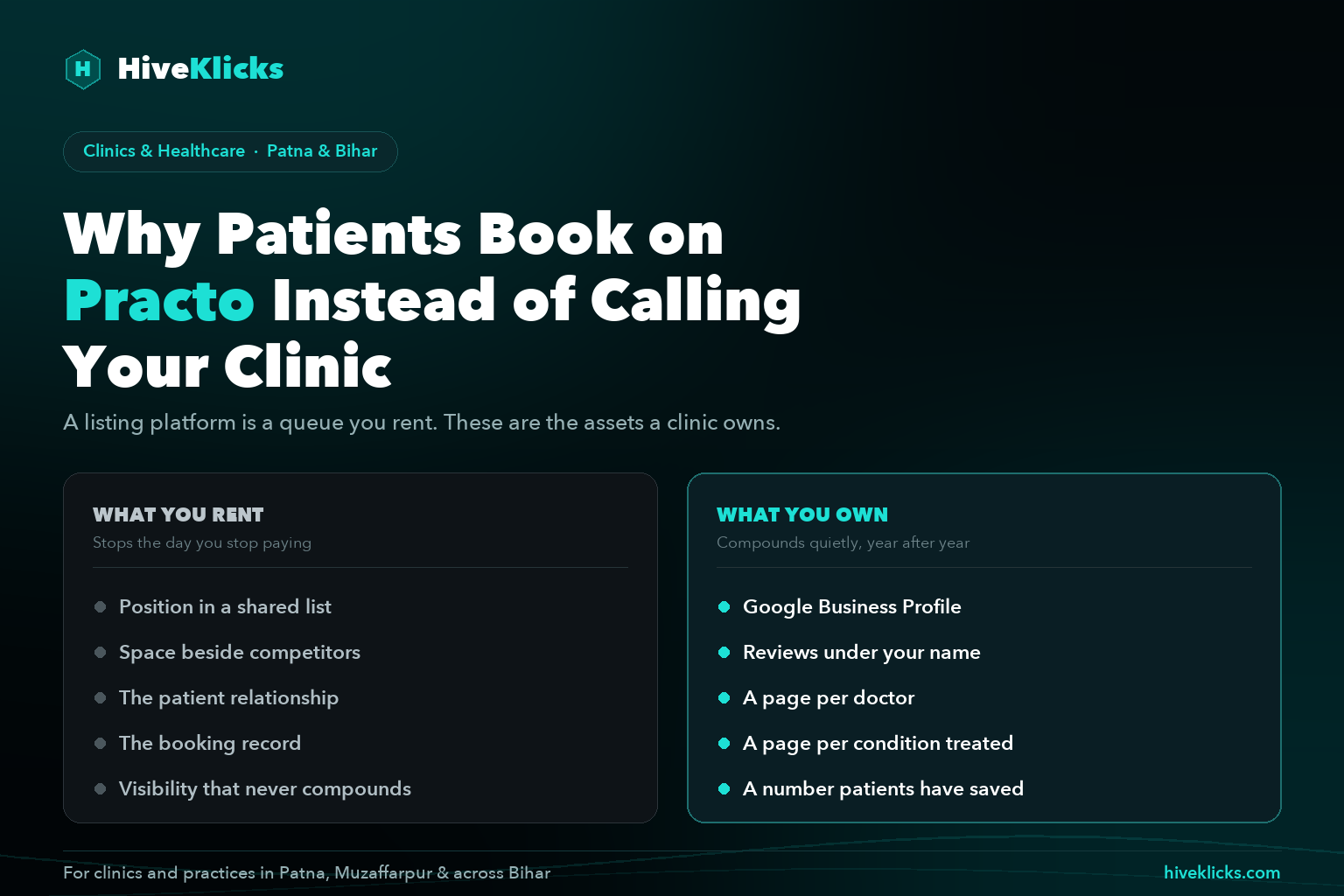
- Visibility is rented, not accumulated. Your position is a function of your current plan and activity. It does not compound over the years the way a Google Business Profile with four years of reviews does, and it does not survive you pausing.
- You appear beside your competitors. That is the value for the patient and the cost for you. A platform's job is to present a comparable set of options; your job, if you rely on it alone, is to be marginally more appealing than the clinic listed directly beneath you.
- The relationship belongs to the platform. The patient's experience is of booking through the app. Repeat visits often route back through the app. The record of who came, why, and how they found you is the platform's asset before it is yours.
Contrast that with the assets a clinic can own outright: a Google Business Profile, a website, a set of reviews attached to your name, a phone number patients have saved. Nobody re-prices those in a quarterly plan revision. They cost time rather than rent, and they get more valuable with age instead of less.
What Platforms Genuinely Do Well
A fair account matters here, because a strategy built on resentment tends to make bad decisions.
Listing platforms are legitimately good at reaching patients who have no doctor yet. Somebody who has just moved to Patna for work has no local recommendation network, no family doctor, and no name to search. A platform gives them a comparable list and an appointment in one step, which is exactly what they need.
They also handle appointment infrastructure that a small clinic would otherwise have to build and staff — slot management, confirmations, reminders. For a solo practice with no front desk after 6pm, that is a real service, not a fee for nothing.
So the correct posture is not withdrawal. It is: keep the platform for the job it does well, and stop letting it do the jobs you should own. Nearly every clinic we look at has that ratio backwards.
The Constraint Most Clinic Marketing Ignores
Any honest article about marketing a clinic in India has to address this, and most skip it.
Registered medical practitioners work under professional conduct regulations that place real limits on advertising and soliciting patients. The boundaries have shifted over the years and continue to be debated, so nothing here should be treated as legal advice — verify the current position with the National Medical Commission and your state medical council before publishing anything promotional.
What matters strategically is that this constraint is far less limiting than clinics assume, because factual information is both permitted and more effective than promotion anyway. Consider what a worried patient at 11pm is actually looking for:
- Qualifications and registration — stated plainly
- What conditions and procedures you handle, and what you do not
- Timings, including which days a particular doctor sits
- Where exactly you are, with a landmark, because addresses in Bihar are landmark-based in practice
- What a consultation costs, or a range, if you are comfortable stating it
- How to get an appointment, in one step
Every item on that list is factual, and every item removes a reason to hesitate. Meanwhile the things the regulations are wary of — claims of being the best, guaranteed outcomes, promotional testimonials — are also the things patients discount instinctively. The constraint and the effective strategy point in the same direction, which is a rarer thing in marketing than it sounds.
The Five Assets a Clinic Should Own
1. A Google Business Profile that is actually maintained
This is the highest-return item on the list and it costs nothing. It is what appears when someone searches for a clinic near them, and it carries your timings, photographs, phone number, directions and reviews in one place.
Maintained means: correct timings including the days a doctor is unavailable, real photographs of the actual waiting area and entrance rather than stock images of foreign hospitals, the right category, and a phone number that someone answers. Clinics that get no calls from Google usually have a listing that was created once and never touched again — the pattern we describe in why most local businesses stay invisible on Google, and the discipline covered end to end in the local SEO playbook for Bihar shops.
2. A page for each doctor
Patients choose people, not institutions. A page per doctor — name, qualifications, registration, areas of focus, days and timings, a photograph taken in this decade — does the verification work that a directory entry cannot, because it is yours and it can be complete.
3. A page for each condition or procedure that matters to you
This is the asset almost no clinic in Bihar has built, and it is the one that compounds. If you treat a condition regularly, there should be a page that explains it in plain language: what it is, what the visit involves, what a patient should bring, roughly what it costs, and when it needs urgent attention.
These pages work for two reasons. They match how patients actually search — by symptom and condition, not by department — and they are exactly the kind of factual, non-promotional content the regulations leave room for. They are also what makes a clinic findable months later, without any spend attached.
4. Reviews attached to your own name
Reviews on your Google Business Profile belong to your clinic, sit where patients are already checking, and accumulate for years. The ethical line is simple and should not be crossed: make it easy for patients who want to review you — a QR code at the desk, a line in a follow-up message — and never incentivise, script or write them. Reply briefly to each one without discussing clinical detail or confirming that any reviewer was a patient. Confidentiality outranks marketing, always.
5. A contact path that works at 11pm
Most clinic websites in Bihar fail here, and it is the cheapest thing on the list to fix. A tappable phone number fixed at the bottom of the screen on mobile. A WhatsApp number for scheduling and directions — not clinical advice. A booking form only if somebody actually monitors it. An unanswered form is worse than no form, because the patient believes they have made contact and then waits.
The Real Reason Patients Choose the App
Here is the uncomfortable part, and it is worth sitting with, because it explains more than any argument about platforms.
Patients often book through an app not because they trust the app more than they trust you, but because the app is available and you are not. The clinic line is engaged through the entire OPD. Nobody picks up after 7pm. Timings on three different internet listings disagree with each other. The number saved in someone's phone from two years ago now belongs to a former receptionist.
A booking button that works at 10pm beats a phone number that works between 5pm and 7pm on alternate days. That is not a technology problem; it is an availability problem wearing a technology costume. Which is good news — availability is fixable without buying anything, whereas out-bidding a platform is not.
The Split: What to Rent, What to Own
A workable division for most clinics in Bihar:
- Rent from the platform: discovery among patients new to the city or with no existing doctor, and after-hours appointment handling if you have no staff for it.
- Own outright: your Google Business Profile, your reviews, your doctor pages, your condition pages, your phone number and your WhatsApp line.
- Never rely on the platform for: repeat patients. If someone who has already visited you twice still books through an app, you are paying for a relationship you already earned. Fixing that is usually as simple as a card with a saved-number instruction handed over at the desk.
That last point is where the money quietly leaks. Acquisition costs are worth paying. Paying them twice for the same patient is not.
A Ninety-Day Sequence
In the order that produces results fastest, not the order that feels most impressive:
- Weeks 1–2. Google Business Profile: claim it, correct the timings, add ten real photographs, fix the category, confirm the phone reaches a person. Make sure the clinic owns the profile, not a vendor.
- Weeks 3–4. A small, fast website: home, one page per doctor, contact and directions with a landmark. Five pages that load quickly beat twenty that do not — the reason speed matters this much is set out in fixing slow sites and recovering rankings. For clinics we build these in the same way as our other hand-coded sites in Patna.
- Weeks 5–8. The review habit: a QR code at the desk, one polite line in the follow-up, a reply to every review. Slow, steady, never bought.
- Weeks 9–12. Condition pages, three to five, covering what you actually treat most. This is the part that keeps working long after the quarter ends.
Note what is absent: advertising. For most clinics, ads are the wrong first move, because paid traffic sent to a clinic with no reviews, no photographs and an unanswered phone converts poorly and teaches you nothing.
How to Tell Whether It Is Working
Do not judge this by website traffic. Judge it by four things, checked monthly:
- Calls and direction requests from your Google Business Profile — the clearest signal that patients nearby are finding you.
- Where new patients say they heard of you — asked at the desk, written down. One line in the register is worth more than any dashboard.
- The share of appointments that come through the platform versus directly. This is the number that tells you whether the balance is actually shifting.
- Repeat patients booking directly rather than through an app.
Those four sit inside a wider set we have written up separately — the 5 marketing numbers worth tracking — and the same logic applies here: a number is only worth recording if a decision changes when it moves.
The Point of All This
A clinic that appears only on a listing platform is one pricing decision away from starting over. A clinic with its own profile, its own reviews, its own pages and its own saved number has something that keeps working during a quiet quarter, and keeps compounding through a busy one.
The platform is not the enemy. Depending on it entirely is the risk. And most of the fix — correct timings, real photographs, a phone somebody answers, honest information written down once — costs attention rather than money.
Building the Owned Side for Your Clinic
HiveKlicks builds fast, factual, mobile-first websites and Google Business Profiles for clinics and practices in Patna, Muzaffarpur and across Bihar — doctor pages, condition pages, directions that work, and a contact path that does not drop patients. Everything written to stay on the factual side of the line doctors work under. Book a call and we will look at what you currently own versus what you rent.
Book a Free Strategy Call →