Every property dealer in Patna has had this month. The lead count is respectable. The spend is what it always was. And almost nobody picks up.
The ones who do answer have already spoken to two other dealers, are tired of repeating their budget, and want to know the price before they will agree to anything. By the fourth call of the day you are not selling property. You are auditioning.
The usual explanation is that the leads are junk. That explanation is comfortable and slightly wrong, and being precise about why matters — because “junk leads” suggests the fix is a better portal or a better plan, while the real diagnosis points somewhere else entirely.
What You Are Actually Buying
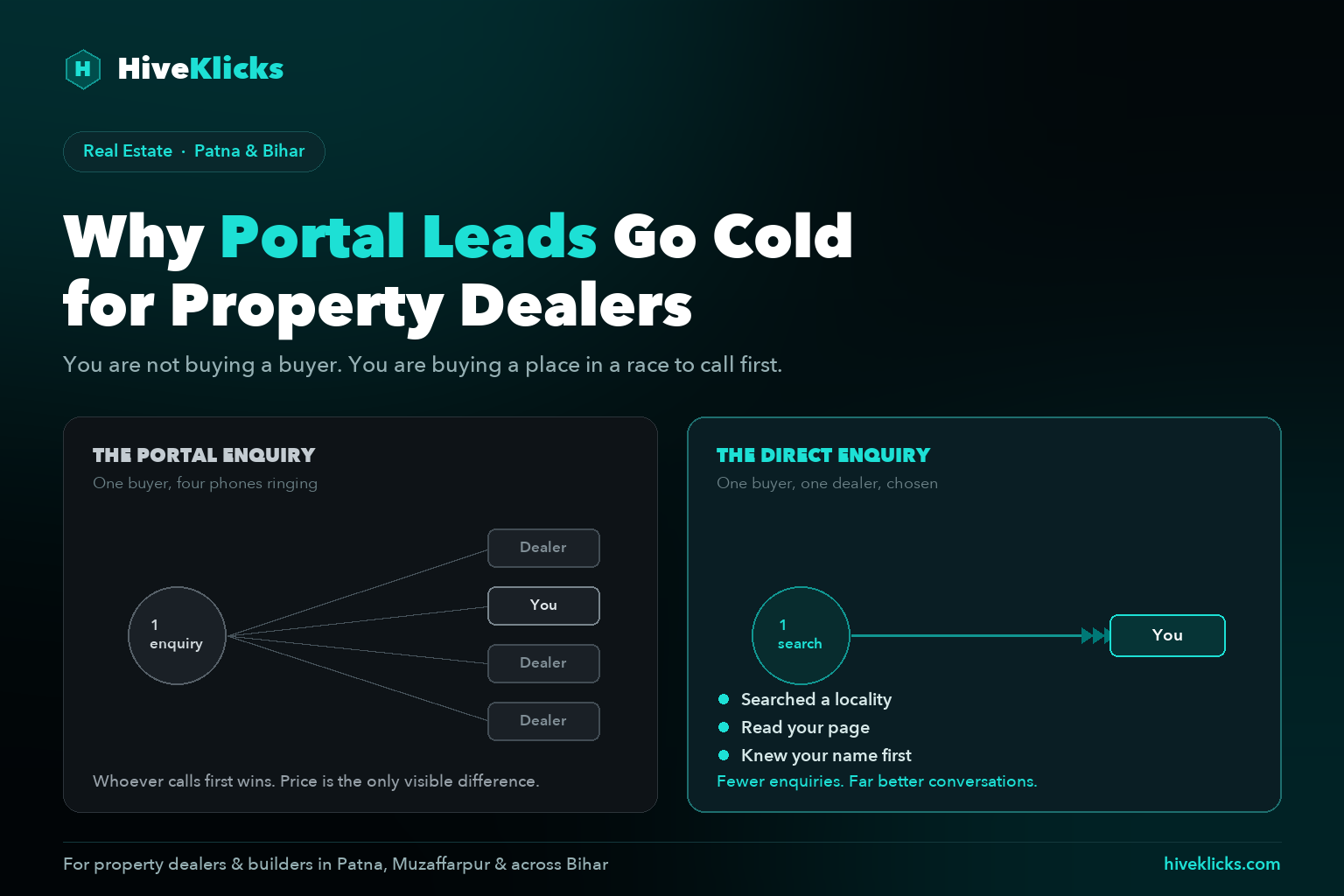
A portal lead is not a buyer. It is a notification that a buyer exists, delivered to you and to several other dealers at close to the same moment.
That single structural fact produces everything dealers complain about:
- You compete on speed, not suitability. Whoever calls first gets the conversation. Nothing about that selects for the dealer who actually has the right property.
- The buyer is exhausted before you reach them. They have explained their requirement three times already. Their patience for a fourth round of qualifying questions is thin.
- The conversation starts on price. With several dealers offering broadly similar inventory, the only visible difference is the number.
- You are anonymous. The buyer chose a listing, not you. Nothing about the enquiry expressed a preference for your firm, so no goodwill exists to draw on.
None of this makes portals dishonest. They are doing exactly what a marketplace does: aggregating supply, presenting comparable options, and distributing demand. The value they deliver to the buyer — choice — is precisely the cost they impose on you.
The Buyer Who Arrives Differently
Now consider a different arrival. Somebody types a locality and a configuration into Google — a three-bedroom in Kankarbagh, a plot near Boring Road, a rental around Bailey Road. They land on a page that covers that locality properly. They read it, look at listings that are actually current, see a name and a photograph and a registration number, and then message on WhatsApp.
That enquiry behaves nothing like a portal lead. They picked you. They know your name before you speak. Their first question is about the property rather than about the price. And crucially, they are not simultaneously talking to three other people about the same requirement.
Dealers who build this route consistently report the same pattern: far fewer enquiries, dramatically better conversations. That trade is almost always worth making, because your constraint is not enquiry volume — it is the hours you can spend on the phone and the site visits you can physically run in a week.
The Metric That Fixes the Argument
Most dealers evaluate channels on cost per lead, which is precisely the number a volume-based model is designed to look good on. Leads are cheap to generate and easy to inflate.
The number that settles the question is cost per site visit. A buyer who agrees to physically go and see a property has spent something real — their Sunday — and that is the first genuine signal of intent in the entire funnel.
Monthly spend on a channel ÷ site visits it produced = the only comparison worth making
Run that for portal enquiries and for direct enquiries separately, for two months, and the argument about where to spend usually resolves itself without anyone having to be persuaded. It sits inside the broader discipline we set out in the 5 marketing numbers worth tracking, where the same principle applies: measure the thing that costs the customer something.
Where the Money Actually Leaks
The visible cost of a shared lead is what you paid for it. The larger costs are the ones that never appear on any invoice.
Your hours. A dealer who spends three hours a day on calls with buyers who have already been qualified by two competitors has lost the most finite resource in the business. Those hours could have run a site visit, or followed up with a past client who is now ready to buy again.
Price anchoring. When four dealers are calling about the same requirement, the conversation collapses to the number almost immediately. You end up quoting defensively, and once a buyer has an anchor in mind, moving them off it costs either margin or the deal.
Discounting to win a race. The dealer who closes a shared lead often does so by giving something away — on brokerage, on terms, on how much unpaid work they will absorb. The lead cost was two hundred rupees; the concession cost considerably more.
Learning nothing. Because the enquiry arrived through someone else's system, you finish the month with no record of which localities people wanted, what budgets were realistic, or which listing photograph made someone stop. A direct enquiry teaches you something. A shared one usually does not.
Add those four together and the true cost per shared lead is a multiple of the printed price. That is the arithmetic that makes building a direct route worth the two or three quarters it takes.
The Three Questions a Buyer Is Silently Asking
Before a buyer in Patna or Muzaffarpur commits to a site visit, they are answering three questions in their head. Almost nothing else matters.
- Is this property real and still available? Old listings, recycled photographs and vague descriptions all fail this one instantly.
- Is this dealer accountable to anyone? A registration number, a fixed office, a real name, a face. In a transaction this size, accountability outranks charm.
- Will this waste my Sunday? The site visit is the buyer's real cost. Anything that reduces the risk of a wasted trip — honest photographs, a floor plan, a straight answer about the price band, a location pin — makes agreeing to it easier.
Every asset described below is really just an answer to one of those three. That is the whole design principle: a property business is not persuading anyone, it is removing doubt.
What a Property Business Should Own
1. Locality pages
This is the highest-value asset for a property business and almost nobody in Bihar has built it properly.
Buyers search by area before they search by dealer. A page per locality you genuinely work in — what is available, what the area is actually like to live in, schools and hospitals nearby, what the connectivity is, roughly what prices look like — meets them at exactly that moment.
The word doing the work is genuinely. A thin page listing three flats in an area you barely operate in helps nobody and ranks for nothing. Two localities covered honestly beat twelve covered thinly, every time. The reason these pages work at all is the same reason set out in the local SEO playbook for Bihar shops: local searches are won with specificity, not volume.
2. Listings that are actually current
Nothing destroys a property enquiry faster than interest in a flat that sold four months ago. It is the fastest way to teach a buyer that your information cannot be trusted, and it happens because updating listings is nobody's specific job.
Real photographs, taken on a real day, including the ones that are less flattering. A buyer who feels a listing was staged to hide something spends the entire site visit looking for what was hidden.
3. A Google Business Profile
Most property dealers in Bihar have none, which makes this an unusually cheap advantage. It is free, it puts your office on Maps, it carries reviews, and it appears when somebody searches for a property dealer near them. If you do one thing from this article this week, do this one — the pattern of what happens without it is documented in why most local businesses stay invisible on Google.
4. Trust signals a large purchase demands
Somebody is about to make the biggest transaction of their life with a person they found on the internet. They are actively hunting for reasons to believe you are accountable: RERA registration details where they apply, a real office address, the names and faces of actual people, evidence of completed deals, a landline that works.
These are unglamorous and they convert better than any promotional language, because the buyer's private question is not “is this the best dealer” but “can this person disappear with my money.”
5. Instagram, for discovery only
Property has become a genuinely visual purchase, and short walkthrough videos travel unusually well — they get forwarded on WhatsApp, which is how a good deal of property discovery in Bihar actually happens now.
Treat it as the top of the funnel. It builds familiarity with you, which is worth a great deal in a high-trust transaction, but the enquiry it produces still has to land somewhere solid. The mechanics of turning that attention into conversations are the same ones we cover for selling through Instagram and WhatsApp, allowing for a much longer decision cycle.
Why WhatsApp Is the Real Sales Floor
For property in Bihar, WhatsApp is not a support channel. It is where the deal actually progresses: floor plans, photographs, a voice note answering a question at 10pm, the location pin before a site visit.
Two things separate dealers who use it well from dealers who use it constantly. The first is speed of first response — not a scripted greeting, a real answer to the actual question. The second is not broadcasting. A daily forward of every listing to everyone you have ever spoken to is the fastest route to being muted, and a muted contact is a lost buyer with no notification to tell you.
One property, one buyer, one reason it might suit them. That is the message that gets replies.
The Channel Dealers Systematically Underuse
Ask a dealer who has been working in Patna for fifteen years where their best deals come from and the answer is never a portal. It is a past client, a builder they know, a lawyer, a friend of a family they helped four years ago.
And yet almost nobody works this channel deliberately. Referrals are treated as weather — pleasant when they arrive, not something you cause.
Causing them is not complicated, but it does require a system: a note in the diary to check in after possession, a message when a locality you sold in gets a new road or school, the paperwork help that costs you an hour and earns you a decade. A buyer's transaction ends at registry. Their usefulness to your business does not.
This is also the channel with the lowest acquisition cost and the highest close rate of anything in this article, which makes its neglect the most expensive habit in the trade.
A Ninety-Day Build Order
In the order that produces results soonest, not the order that looks most impressive to anyone:
- Weeks 1–2. Google Business Profile: claim it, add the office with real photographs, correct hours, and start asking satisfied past clients to review you. Free, and the fastest-moving item on the list.
- Weeks 3–5. A listings site that one person is responsible for keeping current. Fewer listings, all real. Add WhatsApp to every single one — and make sure the site loads quickly on a mid-range phone, for the reasons set out in fixing slow sites and recovering rankings.
- Weeks 6–9. Two locality pages, covering the areas you genuinely know best. Not twelve. Two, written properly.
- Weeks 10–12. The referral habit: a list of past clients, a reason to contact each one, and a diary entry so it actually happens. Plus walkthrough videos of two or three properties.
Through all of it, keep the portal running. This is a build, not a switch, and the point is to reach the position where the portal is one channel among several rather than the only one you have.
The Honest Split
The conclusion is not to leave the portals. It is to stop asking them to do a job they are not built for:
- Keep the portal for: reach among buyers who are still comparing and have no dealer in mind, and for inventory that genuinely benefits from mass exposure.
- Build your own for: buyers who want to choose a dealer rather than a listing — locality pages, current listings, Google presence, WhatsApp.
- Work deliberately on: referrals and repeat business, which cost the least and close the fastest.
Expect two to three quarters before the owned side carries meaningful volume. Keep the portal running while you build. The signal to watch is the share of enquiries arriving directly — when it climbs steadily for two quarters, you have earned the right to renegotiate what you spend on rented reach.
The Part Worth Sitting With
The dealers who complain hardest about lead quality are usually the ones with no route to a buyer except a shared one. That is not a character flaw; it is what happens when a business grows on a channel that works well enough to postpone building anything else.
But a buyer who found you, read about the locality from you, and messaged you by name is a fundamentally different conversation from a buyer whose number you bought at the same time as three competitors. Same market, same inventory, entirely different business.
Building the Direct Route for Your Property Business
HiveKlicks builds locality pages, listing sites and Google presence for property dealers and builders in Patna, Muzaffarpur and across Bihar — fast, honest, WhatsApp-first, and designed so buyers arrive knowing your name. Book a call and we will look at where your enquiries actually come from today.
Book a Free Strategy Call →